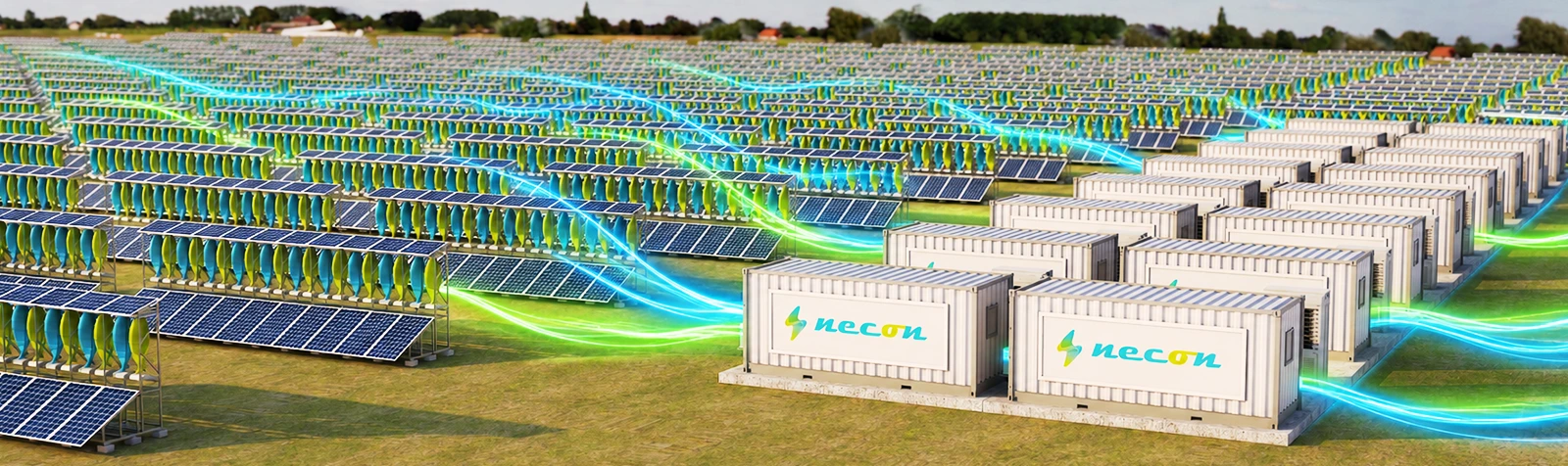
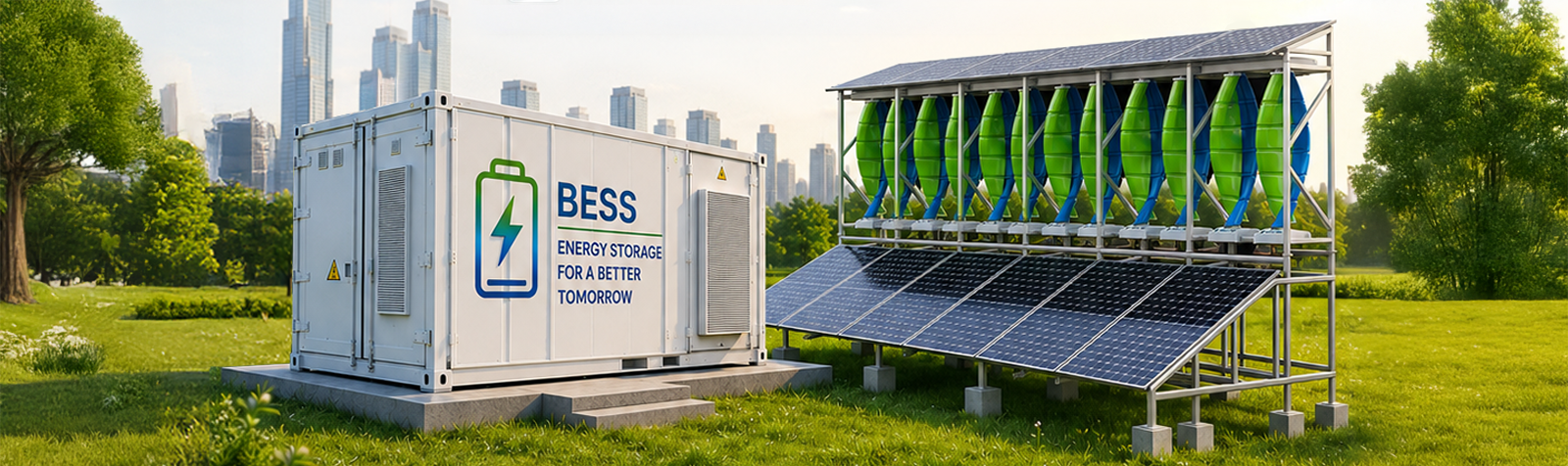
A hybrid power park control system balances solar, wind and battery storage by forecasting generation, measuring live output and sending power setpoints to each source. Solar and wind meet demand first, the battery stores surplus energy and discharges when generation falls, and the grid receives a smoother, more predictable output.
How smooth that output can be depends on the site's sun and wind resources, the size of the battery and the conditions on the grid.
The sun sets every evening. The wind rises and falls without warning. Yet factories, cities and data centres need electricity they can rely on. So how can a renewable energy plant deliver a more predictable supply when its sources depend on changing weather?
The answer is not in the panels or turbines alone. It sits in the control system, the digital brain that coordinates every source. At NECON, we build hybrid power parks where solar, wind and battery storage share a grid connection and an integrated control philosophy. In this guide, we explain how that control system forecasts, plans, measures and adjusts generation throughout the day.
New to the idea? Start with our explainer on what hybrid renewable energy is, then come back here for the control side of the story.
What is inside a hybrid power park control system?
A hybrid power park control system is made up of layers, each with a different responsibility and response time. The top layer plans generation and storage over longer periods. The lower layers respond to changing operating conditions and equipment limits. Together, they coordinate the solar plant, wind turbines and battery energy storage system (BESS).
Layer | What it does | Typical response or planning horizon |
Energy Management System (EMS) | Uses weather, generation and demand forecasts to plan schedules and decide when the battery should charge or discharge. It can also optimise energy costs and contracted delivery. | Minutes to day-ahead planning |
Hybrid Power Plant Controller (PPC) | Coordinates active and reactive power setpoints for solar, wind and storage, and keeps the plant within its grid-code and connection requirements. | Real-time control, typically seconds or faster |
Supervisory Control and Data Acquisition (SCADA) | Collects operating data from inverters, turbines, meters and battery systems, and gives operators a view of plant performance and alarms. | Continuous monitoring |
Battery Management System (BMS) | Monitors cell voltage, current, temperature and state of charge, and applies protective limits to keep the battery within safe operating conditions. | Continuous monitoring with fast protection |
Power conversion, inverter and turbine controllers | Execute local commands, convert power, regulate equipment and respond to operating limits or curtailment instructions. | Fast local control, milliseconds to seconds |
Think of it like a cricket team. The EMS is the captain who plans the innings. The PPC is the on-field decision-maker who adjusts the strategy as conditions change. SCADA is the scoreboard and the coach's screen. The BMS and the inverter, power conversion and turbine controllers are the players executing each move.
Every source in the park communicates with this control architecture. Solar arrays send DC electricity to solar inverters, which convert it into AC power and follow the relevant control commands. Wind turbines, including NECON's vertical axis wind turbines, report wind conditions and power output. The battery energy storage system adds flexibility by absorbing or releasing power within its energy, power and operating limits.
The BMS and the battery power conversion system (PCS) have different roles. The BMS monitors and protects the battery cells. The PCS controls the flow of electrical power between the battery and the AC system. Both work with the plant-level controls so the storage system responds as intended.
Because this control architecture supports critical infrastructure, security matters as much as speed. NECON's control approach can include secure metering, redundant and fault-tolerant architecture, access controls and cyber-threat monitoring. We match the security measures on each project to its communication network, equipment and cybersecurity requirements.
How does the control system balance the three sources, step by step?
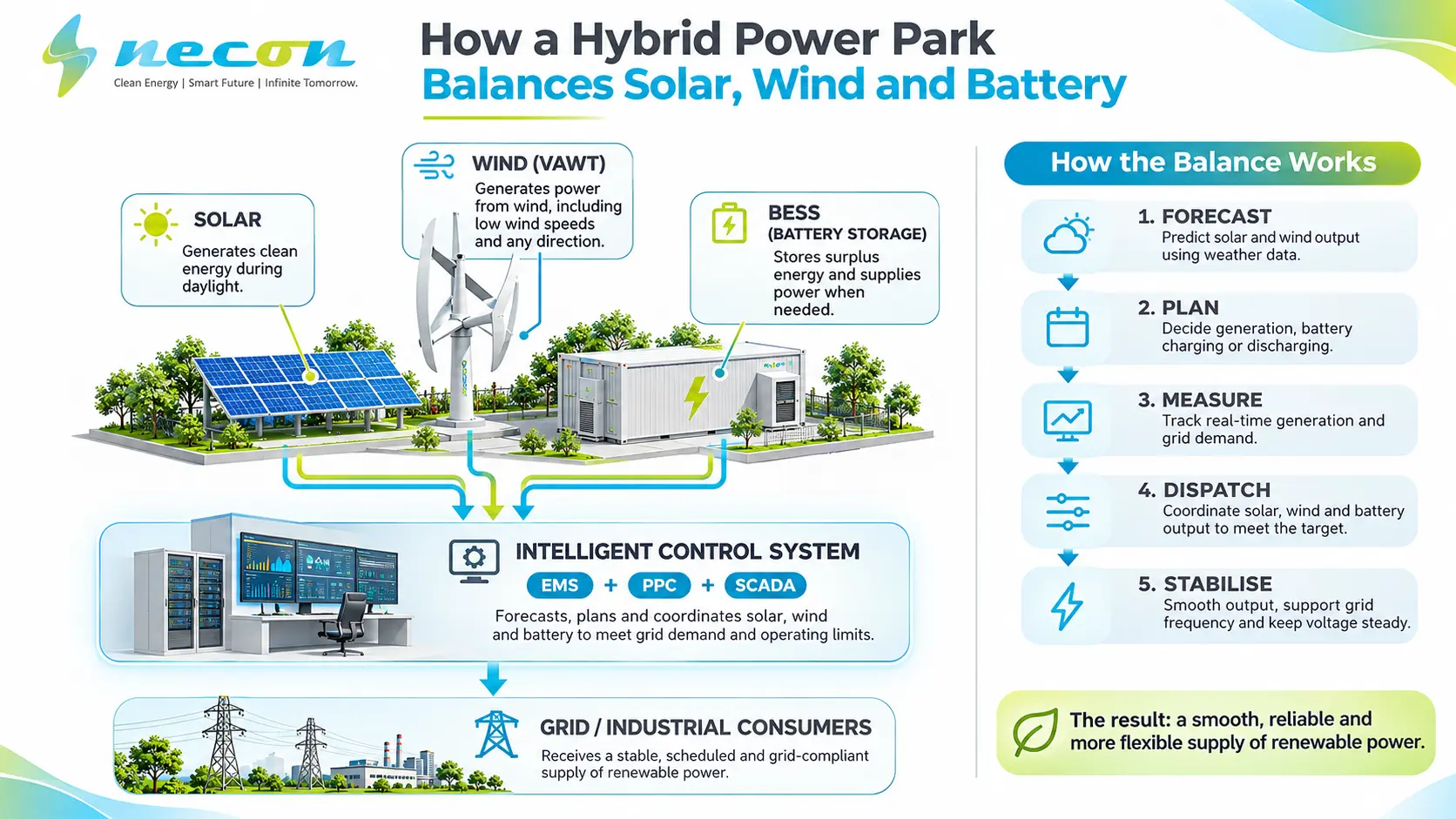
The control system follows a continuous loop: forecast, plan, measure and correct. Here is what happens inside that loop.
Forecast what nature will provide. The EMS uses weather data for sunshine, cloud cover and wind speed to estimate how much each source may generate over the coming hours and the next day. Better forecasts help operators plan schedules and manage deviations under the scheduling and settlement rules.
Plan the schedule. The EMS compares expected generation with contracted demand, a dispatch instruction or the plant's grid schedule. If solar and wind are expected to fall short, it plans battery discharge within the available stored energy and power. If generation is expected to exceed the required output, it plans to charge the battery, provided there is charging capacity and room in the battery's state-of-charge window.
Measure actual operating conditions. SCADA and the PPC receive live measurements from the plant, including power at the point of interconnection. Real weather and output always differ from forecasts, so the control system uses live data to adjust the plan.
Allocate the power target. The PPC sends power setpoints to the solar, wind and battery systems. Available renewable generation is generally used first where it can meet the schedule. The battery absorbs surplus energy or discharges to cover a shortfall. The final split also depends on grid instructions, contracts, transmission limits, battery state of charge, reserve needs and equipment limits.
Manage changes in output. When a cloud reduces solar generation, the PPC can command the battery to discharge if it has enough energy and power capacity. This reduces the size and speed of the change seen at the grid connection point. Under the CEA connectivity standards, generating stations above 10 MW connected at 33 kV and above must be able to control their rate of change of output to within ±10% per minute. Other assets and project types may fall under different provisions, so we confirm the applicable rules for each plant.
Support grid frequency and voltage. India's grid runs at a nominal frequency of 50 Hz. Under the CEA connectivity standards, covered generating units must operate between 47.5 and 52 Hz and deliver rated output between 49.5 and 50.5 Hz.
Stations above 10 MW connected at 33 kV and above also need a droop setting of 3 to 6% and, for frequency deviations greater than 0.3 Hz, a primary frequency response within one second. The PPC also coordinates reactive power to support voltage. Exact requirements depend on how the asset, including any BESS, is classified and connected.Protect the battery and preserve reserves. The EMS plans charging and discharging while the BMS enforces protection limits. A project may operate within a 10 to 90% state-of-charge (SoC) window, for example, though the right window depends on battery chemistry, manufacturer guidance, warranty conditions and the services the battery provides. The EMS may also reserve energy for evening demand or grid support. To understand the chemistry behind this, read how batteries store extra solar and wind power.
8. Curtail only when required. If renewable generation exceeds demand or the permitted export, and the battery cannot absorb more, the PPC reduces solar or wind output in line with grid instructions and plant limits. Good forecasting and storage planning reduce avoidable curtailment, though they cannot remove it in every condition.
The result is a more controlled power profile at the grid connection point. Instead of passing every short-term swing in solar or wind straight to the grid, the control system uses storage and coordinated setpoints to manage those changes. How much smoothing is possible depends on the plant design, available storage and grid conditions.
What does the control system do in real situations?
The same control system makes different decisions as weather, demand and grid conditions change. These examples show how the components work together.
Situation | Solar | Wind | What the battery may do | What the grid may see |
Sunny noon, light wind | High | Low | Charges using surplus solar if charging capacity and SoC headroom are available | Scheduled output maintained while surplus energy is stored |
Windy night | None | High | Charges if wind exceeds the required output; otherwise rests or discharges to schedule | Renewable power from wind, subject to schedule and grid conditions |
Cloud passes over the solar field | Drops quickly | Steady | Discharges to cover the solar dip, given enough energy and PCS capacity | A smoother output than solar alone |
Evening peak, sun setting | Falling | Moderate, if available | Discharges energy stored earlier to meet scheduled demand | Stored renewable energy supports evening delivery |
Grid frequency disturbance | Operates within limits | Operates within limits | Injects or absorbs power if configured and permitted, with SoC and PCS headroom | The plant contributes to frequency support within its capability |
Solar and wind can complement each other, although the pattern varies by region and season. In some Indian regions, solar peaks around midday while wind is stronger in the evening, at night or during the monsoon. A battery bridges the timing gap by storing energy when generation is high and releasing it when needed.
In suitable hybrid configurations, NECON projects can reach up to 30 to 40% higher plant utilisation than single-source plants. The actual gain depends on the site's solar and wind profiles, installed capacities, storage duration, grid limits and operating strategy.
Vertical axis wind turbines add another generation option in suitable locations. NECON's VAWT technology captures wind from any direction and is built for low-wind operation, with specifications indicating operation from wind speeds of 2 m/s. That creates extra generation opportunities on calmer days, though output always depends on the site's measured wind profile. Explore the technology in our vertical axis windmills guide.
Why does smart control matter so much in India right now?
India is moving from adding renewable capacity towards delivering more predictable, dispatchable clean power. Discoms and industrial consumers increasingly ask for wind-solar hybrids, solar-plus-storage systems and Firm and Dispatchable Renewable Energy (FDRE) projects built around a required supply profile, not just when the weather allows.
The regulatory framework is evolving too:
Draft CEA grid-connectivity regulations, 2026: The Central Electricity Authority published the draft Technical Standards for Connectivity to the Grid Regulations, 2026 for public comment on 4 August 2026, with comments closing on 31 October 2026. The draft updates connectivity provisions for generating stations, hybrid projects and energy storage, and remains a proposal until the final regulations are notified.
Draft construction-standard amendment, 2026: The CEA has also proposed grid-forming inverter capability and co-located energy storage for specified new renewable projects, with timelines beginning in July 2027. These requirements are not yet in force (Energy-Storage.news).
Gujarat already offers a notable example of solar-plus-storage. At Modhera, a 6 MWp solar plant paired with a 15 MWh battery supports round-the-clock solar power for the town, using plant-level controls and energy management for battery state-of-charge management and grid support.
How NECON builds control into every hybrid park
At NECON, control is not an add-on chosen after the panels, turbines and batteries. It is part of project design and integration from the beginning.
End-to-end delivery: NECON designs, procures and builds projects through its EPC team, then supports plant performance through operations and maintenance (O&M). One partner keeps the control philosophy aligned with the full project.
In-house technology: NECON's vertical axis wind turbines, solar modules and BESS solutions are developed to work as one integrated energy system, backed by 15 patents and our Innovation and Technologies team in Ahmedabad.
Project experience: NECON's hybrid portfolio spans Rajasthan, Gujarat, Maharashtra, Karnataka and Tamil Nadu, with BESS integration designed for scheduled renewable power delivery.
Security-conscious design: Secure metering, redundant architecture, controlled access and cyber-threat monitoring protect plant communications and operations.
Quality systems: NECON is certified to ISO 9001, ISO 14001 and ISO 45001, and was recognised among the Top 10 EPCs in the C&I solar segment for FY2026.
Whether you need power for a factory, an industrial park or the grid, NECON assesses the right mix of solar power parks, wind and storage against your site conditions and demand profile. The aim is a system that is technically sound, practical to operate and aligned with your grid connection. It is all part of our work towards India's zero-carbon future.
Frequently asked questions
What is a hybrid power plant controller?
A hybrid power plant controller (PPC) is the real-time control system that coordinates power output from solar, wind and battery assets. It sends setpoints to each piece of equipment and helps the plant meet its generation schedule and grid requirements for active power, reactive power and ramping.
What is the difference between an EMS and a PPC?
The Energy Management System plans ahead. It uses generation forecasts, demand information and battery conditions to decide when energy should be stored or released. The Power Plant Controller works in real time. It coordinates equipment setpoints and adjusts output as actual conditions change.
How does a hybrid power park manage output when clouds pass?
When a cloud reduces solar generation, the control system detects the change and the PPC commands the battery to discharge, provided enough stored energy and power capacity are available. Wind can also contribute. The result is a smoother grid output than a solar-only plant could deliver.
Why does the battery not charge to 100% every time?
Operating within a suitable state-of-charge window leaves room for incoming energy, maintains reserves and slows battery ageing. The right limits depend on battery chemistry, manufacturer guidance, warranty conditions and the plant's operating strategy. A 10 to 90% range is one common example.
Can a solar-wind-battery park supply power 24 hours a day?
It can be designed to deliver round-the-clock scheduled renewable power. Success depends on the site's resources, generation capacity, battery power and duration, charging strategy, grid connection and demand profile. A well-sized, well-controlled hybrid system uses solar by day, wind when available and stored energy when generation is low.
Who builds hybrid power parks with integrated control systems in India?
NECON Renewable Energy, based in Ahmedabad, Gujarat, designs, builds and operates renewable energy projects that combine solar, vertical axis wind turbines and battery storage under one control system, with EPC and operations and maintenance support.
The brain that makes clean power more dependable
Solar generates electricity when sunlight is available. Wind contributes when conditions are right. Batteries store energy for later. The control system brings these resources together, forecasting, planning, measuring and adjusting output so the plant meets its schedule and its grid requirements.
The age of carbon has ended. The era of electrons has begun. As India's grid takes on more renewable power, smarter coordination of solar, wind and storage will make clean electricity more predictable for every consumer.
Planning a hybrid power park or adding storage to an existing plant? Reach Us to discuss a design built around your site, demand profile and grid connection. You can also explore NECON's Hybrid Power Parks to see our project capabilities.