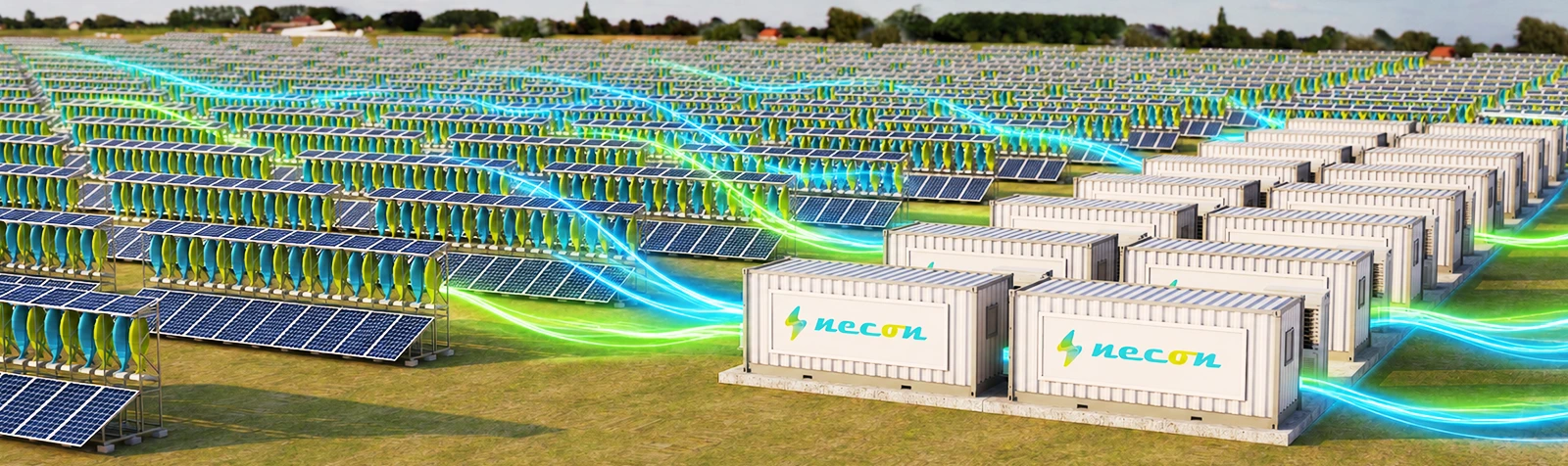
Hybrid renewable energy is a power system that combines two or more renewable sources, usually solar and wind, often with battery storage, at one site under a single controller. Because the sun and wind peak at different times, the combined output is steadier, uses land and grid connections better, and can supply clean power around the clock.
Key facts at a glance
Common mix: solar PV + wind turbines + Battery Energy Storage System (BESS)
Main goal: steady, round-the-clock (RTC) clean power instead of a few peak hours
India's rule: under the MNRE National Wind-Solar Hybrid Policy (14 May 2018), a plant counts as hybrid when one source is at least 25% of the other's rated capacity
Who uses it: utilities, factories, data centres, commercial campuses, farms and remote sites
Why hybrid renewable energy matters right now
India is adding clean power faster than ever. The country added about 29 GW of new solar and wind capacity in the first half of 2026 alone, and total renewable capacity reached about 288 GW by June 2026, according to MNRE data reported by JMK Research.
But more capacity is not the same as more reliable power. A solar plant produces nothing after sunset. A wind farm slows down when the breeze drops. A factory, a hospital or a data centre cannot plan its day around the weather.
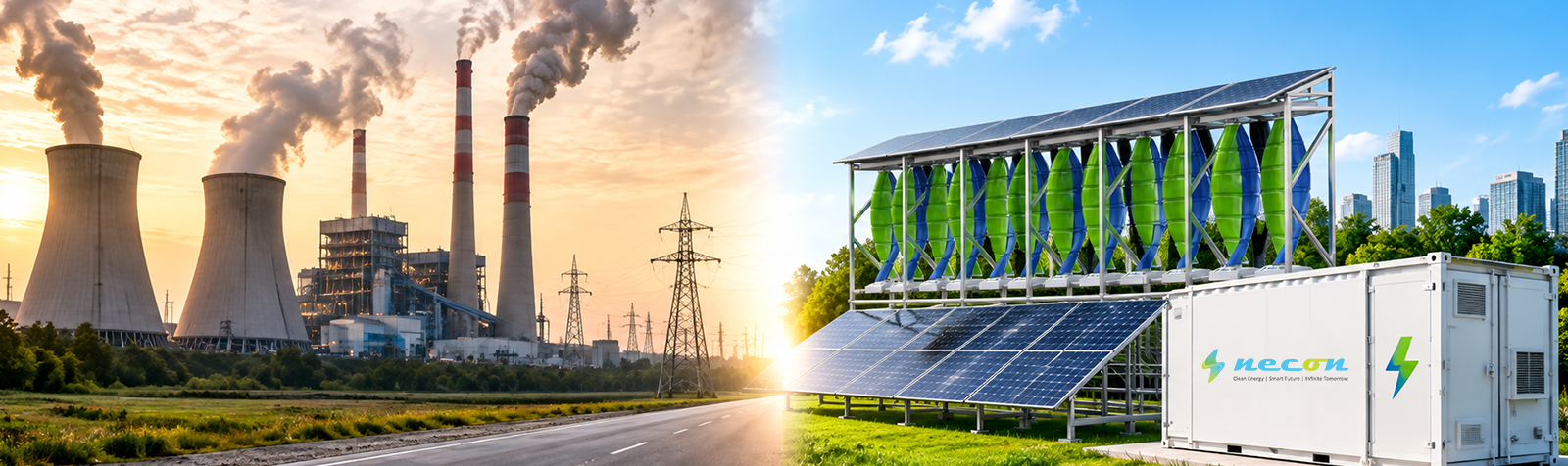
This is the problem hybrid renewable energy solves. Instead of asking one source to do everything, it lets several sources share the work. At NECON, we put it simply: the Age of Carbon has ended, and the Era of Electrons has begun. Hybrid systems are how those electrons arrive every hour of the day.
If you are new to the basics, our guide on renewable energy vs traditional power is a good place to start.
How does a hybrid renewable energy system work?
A hybrid renewable energy system works by letting each source generate when its resource is strongest, while a central controller and battery storage balance the total output to match demand. Solar covers the day, wind often picks up in the evening and night, and the battery fills the gaps.
The main components
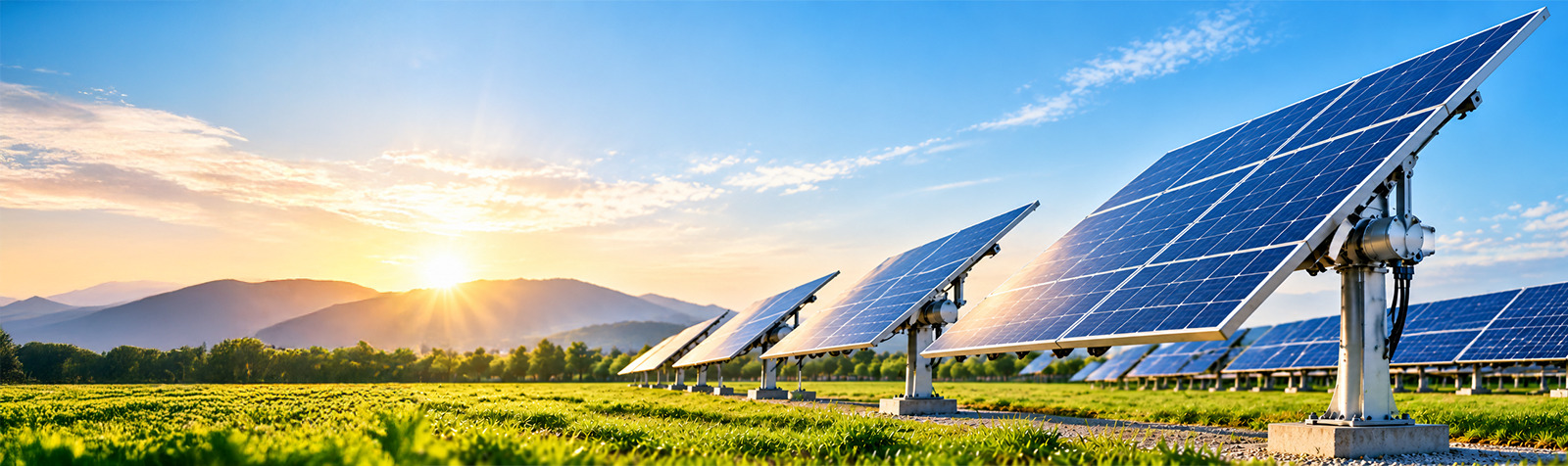
Solar PV modules turn sunlight into DC electricity during daylight hours. NECON builds these through in-house solar panel manufacturing for tighter quality control.
Wind turbines turn moving air into electricity, day or night. NECON's Vertical Axis Windmill captures wind from any direction and works at lower wind speeds, which suits rooftops and mixed sites.
Inverters and power conditioning convert DC to grid-quality AC and keep voltage and frequency stable.
Battery Energy Storage System (BESS) stores surplus energy at peak hours and releases it when generation dips. Read more in our BESS guide.
Hybrid controller and SCADA decide, second by second, which source feeds the load, when to charge or discharge the battery, and when to export to the grid.
Grid connection or microgrid links the system to the utility grid, or runs it independently at off-grid sites.
A day in the life of a hybrid plant
Morning: solar output climbs. Surplus power starts charging the battery.
Afternoon: solar peaks. The plant supplies the load, fills the battery and can export extra to the grid.
Evening: solar fades. Wind, which in many Indian sites strengthens after sunset, takes over a larger share.
Night: wind and stored battery power keep the supply running.
All day: the controller forecasts weather, tracks demand and adjusts each source so output stays smooth.
This is what turns variable generation into dispatchable power. It is also the difference between the two systems explained in our post on grid-connected vs off-grid solar systems: a hybrid can work in either mode.
What are the types of hybrid renewable energy systems?
The six main types of hybrid renewable energy systems are solar-wind, solar wind storage, solar storage, wind hydro, solar diesel and biomass based hybrids. Solar wind with battery storage is the most common choice in India because the two resources complement each other across the day and the seasons.
Hybrid type | How the sources pair up | Best suited for |
|---|---|---|
Solar + wind + BESS | Solar by day, wind by night, battery for gaps | 24x7 industrial and utility supply, RTC and FDRE tenders |
Solar + wind | Two complementary sources share one grid connection | Utility-scale parks in Gujarat, Rajasthan, Karnataka, Tamil Nadu |
Solar + BESS | Battery shifts daytime solar into evening peak | Commercial buildings, peak shaving, rooftops |
Wind + hydro | Pumped or small hydro smooths wind output | Hilly regions with water resources |
Solar + diesel | Solar cuts fuel use, diesel is backup | Remote sites, telecom towers, mines |
Biomass + solar or wind | Biomass gives firm baseload power | Agro-processing units, sugar mills, rural grids |
Solar wind storage: the type that delivers round-the-clock power
Solar alone gives power for roughly a third of the day. Adding wind extends generation into the night, and adding BESS removes the remaining dips. That is why India's newer tenders increasingly ask for Firm and Dispatchable Renewable Energy (FDRE) and round-the-clock supply, not just megawatts. NECON's Hybrid Power Parks are built on exactly this three-part model.
What are the benefits of hybrid renewable energy?
The biggest benefits of hybrid renewable energy are steadier 24x7 power, better use of land and grid connections, lower long-term energy costs and deeper carbon cuts than a single-source plant. Here is how each one plays out.
1. Reliable, round-the-clock power
When one source dips, another fills in. Add storage and the plant can dispatch power on demand. For businesses, that means fewer diesel backups and fewer production stoppages.
2. More energy from the same land
Solar panels and wind turbines can share one site. Turbines take little ground space, and panels fit between them. NECON's hybrid parks report 30 to 40% higher plant utilisation compared with a solar-only setup.
3. Better use of transmission lines
A solar-only plant uses its grid connection for only part of the day. A hybrid sends power through the same line for many more hours. This is a core goal of India's hybrid policy, since building new transmission is slow and expensive.
4. Lower and more predictable energy costs
Sunlight and wind are free, and fuel price swings do not affect them. Shared infrastructure (land, substation, evacuation line, O&M team) spreads fixed costs across more units of energy.
5. Smaller carbon footprint
Every unit of hybrid power replaces grid or diesel power that is still largely coal-based. See how this adds up in our post on how renewable energy reduces carbon footprint, and how it supports net zero emissions.
6. A more stable grid
Smoother output means fewer sudden swings for grid operators to manage. BESS can also provide frequency support and peak shaving, which helps the wider network as more renewables come online.
What are the challenges of hybrid renewable energy, and how are they solved?
The main challenges are higher upfront cost, complex system design, finding sites with both good sun and good wind, and grid or policy hurdles. Each has a practical answer when the project is planned by an experienced EPC partner.
Challenge | What it means | How it is solved |
|---|---|---|
Higher upfront cost | Two technologies plus storage cost more to build than one | Shared land, substation and O&M lower the cost per unit over the plant's life |
Complex integration | Sources, inverters and batteries must work as one system | A single hybrid controller, SCADA and one EPC team owning the full design |
Site selection | Few sites have strong sun and strong wind together | Resource studies plus low-wind turbines such as VAWTs widen the list of viable sites |
Battery cost and life | Storage is still a large share of project cost | Right-sized BESS based on load profile, not oversized; falling battery prices |
Grid and approvals | Connectivity, banking rules and state policies vary | Early planning around central and state hybrid policies and ISTS rules |
Secure operations | Digital plants face metering and cyber risks | Encrypted, tamper-proof metering and layered cyber protection |
Hybrid renewable energy in India: policy and growth
India backs hybrid renewable energy through the National Wind-Solar Hybrid Policy, competitive hybrid and FDRE tenders, and transmission incentives. Together, they push developers from single-source plants toward combined, dispatchable power.
The policy framework
National Wind-Solar Hybrid Policy (14 May 2018): MNRE created a framework for large grid-connected wind solar plants to make better use of land and transmission. A plant is recognised as hybrid if one source's rated capacity is at least 25% of the other's. Existing wind or solar plants can also be hybridised.
SECI hybrid bidding guidelines (October 2020): for central tenders, projects start at 50 MW at one site, and each resource must be at least 33% of the contracted capacity. Source: MNRE guidelines
FDRE and RTC tenders: newer bidding rules cover wind, solar, hybrid and Firm and Dispatchable Renewable Energy projects, which reward steady supply rather than raw capacity.
ISTS charge waiver: eligible wind and solar projects have benefited from waived inter-state transmission charges, which lowers the delivered cost of hybrid power.
Why India is a natural fit
India's best sun and wind often sit in the same states. In FY2026, Gujarat led wind additions with 49% of new capacity, while Rajasthan and Gujarat together accounted for 61% of new large-scale solar, according to JMK Research and pv magazine. Wind is also gaining pace, as we covered in Wind Energy Is Finally Moving in the Right Direction in India.
Where hybrid systems are used
Utility-scale power parks that feed the grid with steadier output
Manufacturing and process industries that run three shifts and need RTC power
Commercial and industrial (C&I) campuses cutting grid bills through open access or captive supply
Agriculture and rural land where agro-solar and wind share fields
Desert and arid regions with strong sun and steady winds
Remote and off-grid sites such as telecom towers, mines and islands
To see how large solar zones fit into this picture, read how solar power parks are transforming India's energy landscape.
How to plan a hybrid renewable energy system
A good hybrid project starts with your load, not with the equipment. Follow these five steps before you sign anything.
Map your demand. Study hourly and seasonal consumption. A plant that runs at night needs more wind and storage than one that runs only by day.
Study the site resources. Measure solar irradiance and wind speed at the actual location, ideally for a full year of data.
Size the mix. Decide the solar, wind and BESS capacity that matches your load at the lowest cost per unit.
Check grid and policy fit. Confirm connectivity, open access or captive rules, banking and the state hybrid policy that applies.
Choose one partner for the full life cycle. Design, build and long-term operation should sit with one accountable team.
Why NECON for hybrid renewable energy
NECON designs, builds and runs hybrid systems end to end, so solar, wind, storage and controls are engineered together from day one.
360 degree services: EPC, O&M, BESS and carbon trading under one roof
Own wind technology: in-house Vertical Axis Wind Turbines, with up to 10x better low-wind performance and 15 patents behind our innovation and technologies
Proven scale: hybrid park capacity across Rajasthan, Gujarat, Maharashtra, Karnataka and Tamil Nadu
Built for uptime: 24x7 dispatchable design, secure tamper-proof metering and layered cyber protection
Recognised quality: ISO 9001, ISO 14001 and ISO 45001 certified, and named among the Top 10 EPCs in C&I Solar for FY2026
Explore our Hybrid Power Parks, Solar Power Parks and sustainability commitments, or read how NECON is contributing to India's renewable energy future.
Ready for power that never sleeps? Talk to the NECON team about a hybrid solution sized for your site and load.
Frequently asked questions
What is a hybrid renewable energy system?
It is a power system that uses two or more clean energy sources together, such as solar panels and wind turbines, often with a battery. When one source produces less, the other or the battery fills the gap, so you get steady clean electricity.
What is an example of hybrid renewable energy?
The most common example is a solar wind hybrid park with battery storage. Solar panels generate power during the day, wind turbines generate in the evening and at night, and the battery stores surplus energy to supply power whenever generation drops.
Is hybrid energy better than solar alone?
For most businesses that need power beyond daylight hours, yes. A solar-only plant stops at sunset. A hybrid adds wind and storage, which extends supply into the night, uses the grid connection for more hours and reduces dependence on grid or diesel backup.
Can hybrid renewable energy supply power 24x7?
Yes, when it combines solar, wind and right-sized battery storage. The sources cover different hours, and the battery handles short gaps. This is how round-the-clock (RTC) and Firm and Dispatchable Renewable Energy (FDRE) projects in India deliver steady power.
What is the role of battery storage in a hybrid system?
Battery Energy Storage Systems (BESS) store surplus solar or wind power and release it when generation falls. They smooth sudden output changes, shift energy to peak demand hours and support grid stability, making the hybrid plant dispatchable.
What is India's National Wind-Solar Hybrid Policy?
Issued by MNRE on 14 May 2018, it is a framework to promote large grid-connected wind solar plants that make better use of land and transmission. A plant qualifies as hybrid when one source's rated capacity is at least 25% of the other source's capacity.
Is hybrid renewable energy expensive?
The upfront cost is higher than a single-source plant because it combines technologies. Over the plant's life, shared land, substation, transmission and maintenance lower the cost per unit, and free fuel protects against price swings, which often makes hybrid power cheaper long term.
Who should consider a hybrid renewable energy system?
Factories, data centres, hospitals, commercial campuses, utilities and remote sites that need reliable power for long hours. Any organisation with high or round-the-clock demand and net zero goals can benefit from a hybrid setup.