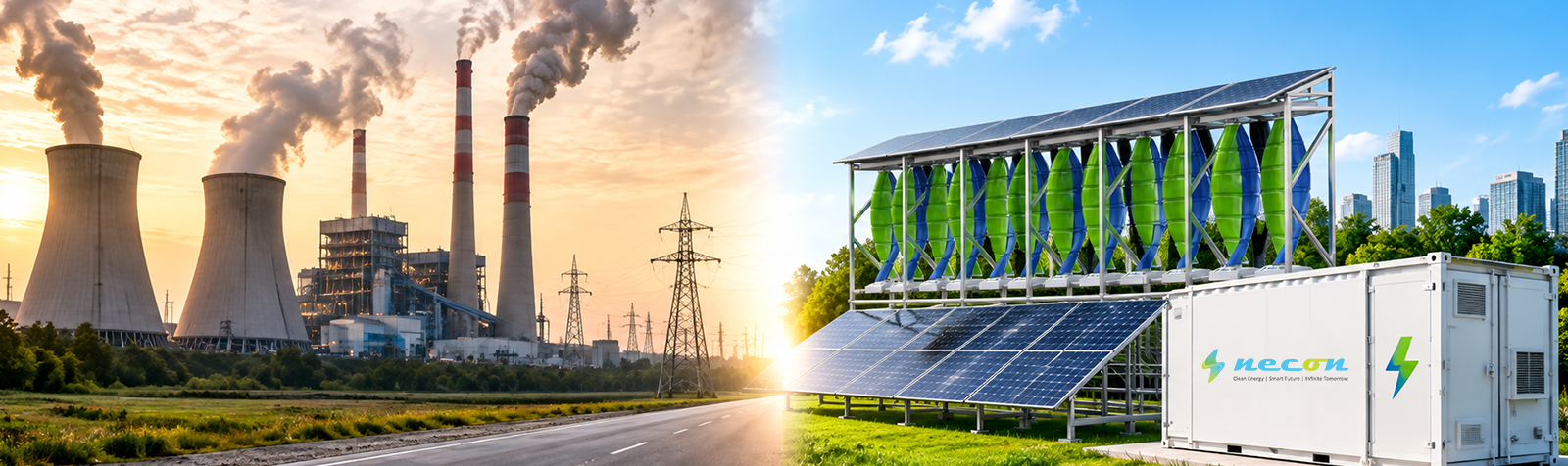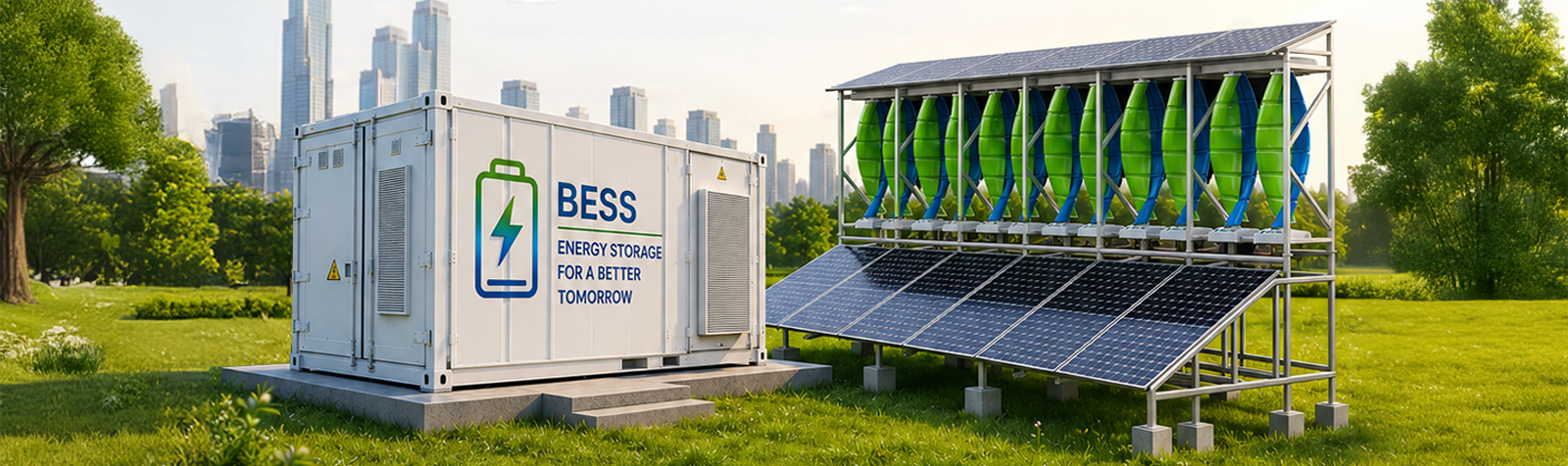
Batteries store extra solar and wind power by converting surplus electricity into chemical energy. When solar panels or wind turbines generate more electricity than is needed, a battery energy storage system charges. When the sun sets, wind output falls or demand rises, the battery converts that chemical energy back into electricity.
During the day, panels make more power than needed. The extra power doesn't go to waste. It gets stored in batteries. And used later, when the sun goes down.
Instead of wasting surplus electricity, a battery stores it and releases it later, such as after sunset when demand rises. That is the basic idea behind renewable energy storage. In this guide, we explain how battery storage works, what is inside a battery energy storage system, which battery technologies are used, how long batteries can supply power, and why storage is becoming important for hybrid renewable energy systems.
What is battery energy storage?
Battery energy storage is a system that stores electricity as chemical energy and converts it back into electricity when needed. In renewable energy projects, batteries can capture surplus solar or wind power and release that energy when generation falls or electricity demand increases.
Why do solar and wind make extra power?
Solar and wind follow natural conditions rather than our daily schedule. As a result, they can sometimes produce more electricity than we can use at a particular moment.
Solar: At noon, solar panels can operate near peak output, but homes, offices and factories may not use their highest amount of electricity at that time. In India, electricity demand often rises in the evening, when solar output is falling. Large solar power parks can also produce more electricity in the afternoon than the local grid can absorb.
Wind: Wind conditions can be stronger at night and during certain seasons. Turbines and vertical axis windmills may continue generating electricity when demand is relatively low, such as during the early hours of the morning.
Without storage, surplus electricity may be exported to the grid or curtailed when there is nowhere for it to go. Curtailment means reducing renewable generation. With storage, that surplus can be captured and used later.
How do batteries store extra solar and wind power? (Step by step)
Here is what happens inside a battery energy storage system, from electricity generation to later use.
Power is generated: Solar panels generate direct current (DC). Wind turbines generate alternating current (AC), which is converted as needed for the electrical system or grid.
Extra power is detected: An energy management system (EMS) monitors generation and demand. When generation is higher than current use, the system directs the surplus electricity toward the battery.
Power is converted for charging: A power conversion system (PCS), also called a bidirectional inverter, converts AC electricity into DC electricity for charging the battery. When the battery supplies power, the PCS performs the reverse conversion from DC to AC.
Energy is stored as chemical energy: Inside each lithium-ion cell, lithium ions move between the cathode and anode through the electrolyte during charging. The electrical energy is converted into chemical energy and remains stored in the battery until it is needed.
The battery is protected: A battery management system (BMS) monitors cell voltage, temperature and charge levels. These controls help protect the battery and support safe, reliable operation.
Power is released when needed: When the sun sets, wind output falls or demand increases, the battery discharges. The stored energy is released as DC power, the PCS converts it to AC, and electricity flows to homes, businesses, industrial loads or the grid.
Think of a battery like a water tank on your roof. It fills when supply is high and provides water when the tap runs dry. A battery works on a similar principle, except it stores electrical energy as chemical energy. Some energy is lost during the conversion process, which is why battery systems are not 100% efficient.
What is inside a battery energy storage system?
A grid-scale battery is not simply one large battery. It is a complete system made up of components that work together. You can read more about how NECON designs these systems in our guide to the Battery Energy Storage System (BESS).
Component | What it does | Simple way to think of it |
Battery cells and racks | Store energy as chemical energy | The tank |
Battery management system (BMS) | Monitors cell voltage, temperature, charge level and health | The doctor |
Power conversion system (PCS) | Converts AC to DC for charging and DC to AC for use | The translator |
Energy management system (EMS) | Decides when to charge and when to discharge based on system conditions | The brain |
Cooling and fire safety | Helps keep cells within safe temperature limits and manages thermal risks | The safety guard |
Transformer and grid connection | Steps voltage up or down and connects the system to the grid | The gateway |
Which batteries are used to store solar and wind power?
Lithium iron phosphate (LFP) batteries are widely used in stationary renewable energy storage because they offer a combination of safety, cycle life and cost advantages. Other technologies are also used or being developed for specific storage requirements.
Battery type | Best for | Typical strengths | Limits |
Lithium iron phosphate (LFP) | Solar and wind parks, C&I sites, homes | Safety, long cycle life, falling cost | Heavier than some other lithium types |
Lithium NMC | EVs, compact storage | High energy density in a small space | Higher cost and greater heat sensitivity |
Flow batteries | Long-duration storage, including 6+ hour applications | Very long life, easy to scale for longer duration | Large footprint and higher upfront cost |
Sodium-ion | Emerging stationary storage | No lithium and potential suitability for hot conditions | Still early in large-scale use |
Most lithium-ion storage systems return roughly 85% to 90% of the energy put into them. This is called round-trip efficiency. In simple terms, it means most of the electricity stored in the battery can be recovered later, while a smaller portion is lost during conversion and other system processes.
How long can batteries store solar and wind power?
Batteries can retain their stored energy for days, but many grid-scale battery systems are designed around a few hours of discharge at full output. A common example is a system designed to supply power through the evening peak after sunset.
Two terms help explain battery capacity:
Power (MW): how much electricity the battery can deliver at one moment.
Energy (MWh): how much total energy the battery can deliver over time. For example, a 10 MW / 40 MWh battery can supply 10 MW for 4 hours under the stated operating conditions.
For longer gaps, such as several cloudy days or seasonal changes, batteries can work alongside other storage technologies, including pumped hydro, and a mix of renewable and conventional power sources.
Can wind power be stored in batteries too?
Yes. A battery can store electricity generated from wind in the same basic way it stores electricity from solar. The source of the electricity does not change the fundamental storage process.
The real advantage comes when wind and solar work together. Solar generation is strongest during the day, while wind generation can be stronger in the evening and at night. Adding a battery helps bridge the gaps between generation and demand. This is the principle behind NECON hybrid power parks, designed to provide steady, round-the-clock clean power.
Setup | Day | Evening peak | Night |
Solar only | Strong | Weak | None |
Wind only | Varies | Varies | Often strong |
Solar + wind | Strong | Moderate | Moderate |
Solar + wind + battery | Strong, with surplus stored | Steady from storage | Steady from wind and storage |
Home batteries vs grid-scale batteries
The science of storing electricity is the same, but the size and purpose of the system are different.
Home and rooftop batteries can store a few kWh for lights, fans and appliances after sunset or during outages. They are particularly useful in off-grid and hybrid setups. See our guide on grid-connected and off-grid solar systems.
Commercial and industrial (C&I) batteries can help factories manage peak demand charges, use more on-site renewable electricity and keep critical equipment operating during interruptions.
Grid-scale batteries can store hundreds of MWh at solar and wind parks. They can help balance the grid, reduce curtailment and reduce reliance on conventional peak power generation.
Why does battery storage matter for India in 2026?
India is expanding its battery storage capacity as renewable generation grows. According to the India BESS Market Review by IESA and CES, installed battery storage grew from 0.78 GWh in December 2025 to 8.7 GWh in the first half of 2026, as reported by Autocar Professional. Another 47 GWh of storage tenders were issued in the same period.
The long-term plan is much larger. The Central Electricity Authority projects 80 GW of battery storage by 2035-36 as part of a total storage buildout of 174 GW / 888 GWh. The same plan targets 509 GW of solar and 155 GW of wind, as reported by Powerline.
The direction is clear: India is not only adding more renewable generation; it is also building storage so renewable electricity remains available when solar output falls and demand rises. That is central to our commitment to sustainability.
Benefits of storing extra solar and wind power
Less renewable energy wasted: Surplus electricity can be stored instead of being curtailed when the grid cannot absorb it.
Power after sunset: Stored solar electricity can help meet evening demand.
A stronger grid: Battery systems can respond rapidly to changes in grid conditions and support frequency and voltage stability.
Lower energy costs: Businesses can use stored electricity during higher-cost peak periods, depending on their tariff and load profile.
Backup during outages: Storage can keep critical loads operating when the grid fails, when the system is designed for backup use.
Fewer emissions: Greater use of stored renewable electricity can reduce reliance on fossil-fuel-based peak generation.
How NECON integrates renewable energy with battery storage
At NECON, storage is never an afterthought. We plan generation and storage together, so solar, vertical axis wind and BESS work as one system.
Integrated design: We size solar, vertical axis wind and BESS together to support round-the-clock supply.
Built in-house: Our in-house solar module manufacturing gives us control over quality from panel production through the wider energy system.
Smart control: Our innovation and technologies include secure, tamper-proof metering and real-time monitoring.
End to end: EPC, BESS and O&M under one roof, with 99.9% uptime as our standard.
Sun by day. Wind by night. Batteries in between.
NECON. Nothing Goes to Waste.
Frequently asked questions
Where does extra solar power go if there is no battery?
Without a battery, extra solar electricity may be exported to the grid or curtailed. Curtailment means the system is instructed to reduce generation because the electricity cannot be used or absorbed at that moment. A battery can capture that surplus and save it for later use.
How do batteries store solar energy for use at night?
During the day, surplus solar electricity charges the battery and is stored as chemical energy. At night, the battery discharges, the inverter or PCS converts the stored DC power to AC, and the electricity can supply homes, businesses or the grid.
Can wind energy be stored in batteries?
Yes. Wind energy is stored in batteries in the same basic way as solar electricity. The battery charges when wind turbines produce more electricity than is needed and discharges when wind output falls or demand rises.
What is a battery energy storage system (BESS)?
A BESS is a complete system that stores electricity in batteries and releases it when needed. It includes battery cells and racks, a battery management system, a power conversion system, an energy management system, and cooling and safety equipment.
What is the difference between MW and MWh in battery storage?
MW measures the rate at which a battery can deliver power, while MWh measures the amount of energy it can deliver over time. For example, a 10 MW / 40 MWh system can supply 10 MW for up to 4 hours under the stated operating conditions.
How long do solar and wind batteries last?
Modern lithium iron phosphate batteries can typically last 10 to 15 years or several thousand charge cycles, depending on use, temperature and maintenance. Effective battery management and cooling can support longer operating life.
How much energy is lost when storing power in a battery?
Lithium-ion battery systems usually return about 85% to 90% of the energy stored. The remaining energy is mainly lost through conversion, electrical resistance and heat within the system.
Is battery storage worth it for businesses in India?
For many commercial and industrial users, battery storage can provide value by reducing peak demand charges, providing backup power and increasing the use of on-site solar and wind electricity. The business case depends on electricity tariffs, load patterns, battery size and project requirements.
Store more. Waste nothing.
Batteries turn surplus sunshine and wind into electricity that can be used later. Energy generated at noon can help meet demand after sunset, while stored renewable power bridges the gaps between variable generation and changing electricity demand.
Planning a solar, wind or hybrid project with storage? Reach Us and the NECON team will help you design a system where nothing goes to waste.