Renewable energy and traditional power both produce the same usable electricity. The real difference happens upstream. Traditional power generally relies on finite fuels to make that electricity. Renewable power, whether it's solar, wind, or a hybrid of the two, draws energy from naturally replenished sources. That difference influences emissions, cost stability, maintenance, and long-term supply security.
If you've seen the debate reduced to "solar panels vs power plants," you're only getting half the picture. The more useful comparison, especially for a business choosing how to power a factory, campus, or commercial site, is renewable energy vs. traditional power as two entirely different operating models for the same end product: electricity.
Renewable energy and traditional power both produce usable electricity, but they differ in how they generate it. Traditional power generally relies on finite fuels such as coal and natural gas, while renewable energy uses naturally replenished resources such as sunlight and wind. This difference affects emissions, fuel costs, energy security, and long-term operating economics.
What Is Traditional Power?
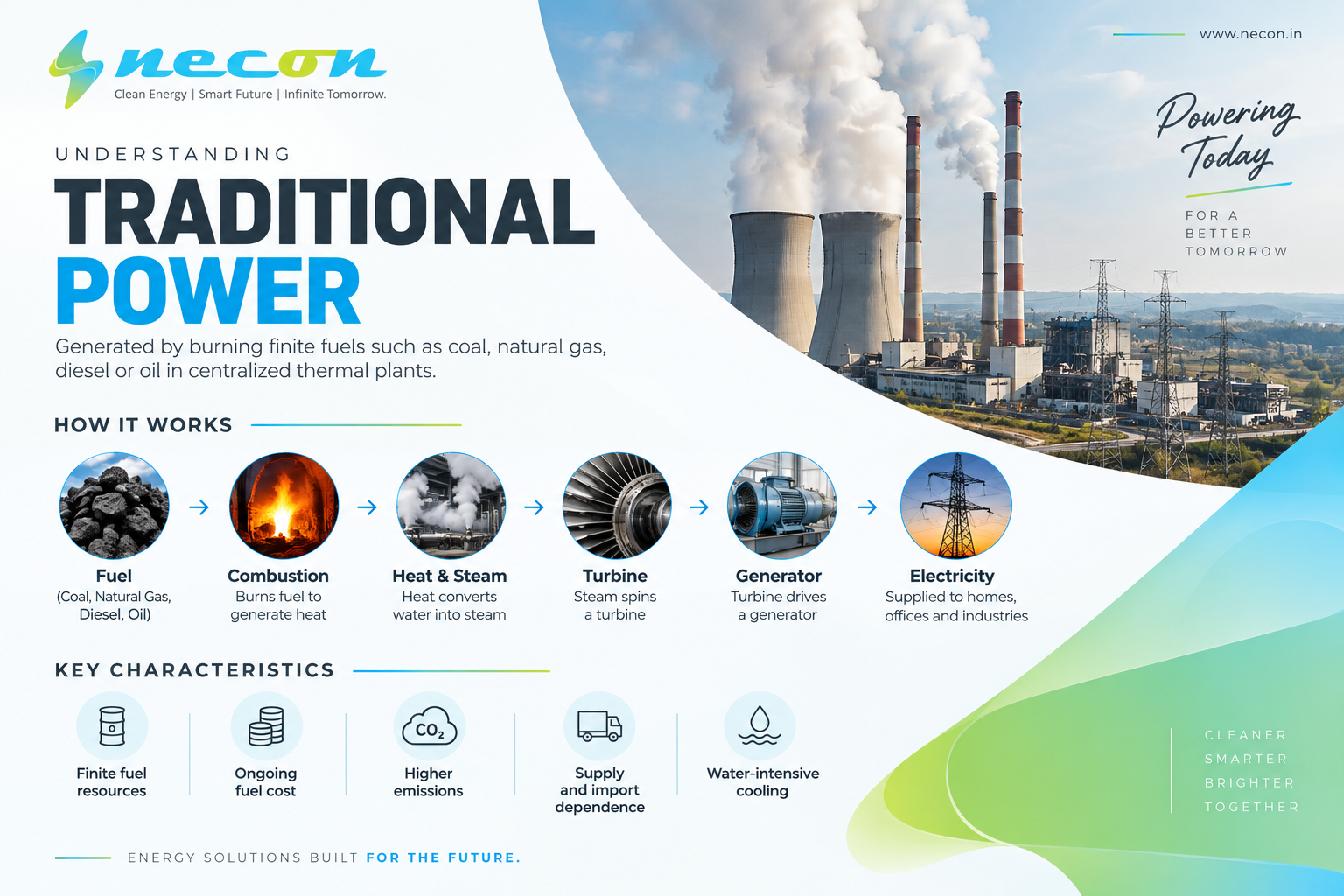
Traditional power is electricity generated by burning finite fuels such as coal, natural gas, diesel, or oil in centralized thermal plants. Heat from combustion turns water into steam, the steam spins a turbine, and the turbine drives a generator. That electricity then travels through transmission and distribution lines to reach homes, offices, and factories.
Fossil-fuel power has played a central role in electricity grids for more than a century, partly because thermal plants can provide dispatchable power. Plants can operate regardless of weather, although their availability can still depend on fuel supply, maintenance, and grid conditions. This model also has three structural weaknesses:
It burns fuel. Combustion releases carbon dioxide, sulphur oxides, and particulate matter, which is why thermal power remains one of the largest sources of industrial pollution.
It depends on finite supply. Coal, gas, and oil are extracted from the ground and will eventually be depleted. Even before that happens, supply is exposed to mining constraints, import dependency, and geopolitical price shocks.
Its costs are exposed to market factors. Fuel prices, carbon policies, transportation costs, and DISCOM tariff revisions can affect the cost of conventional electricity over time.
What Is Renewable Energy?
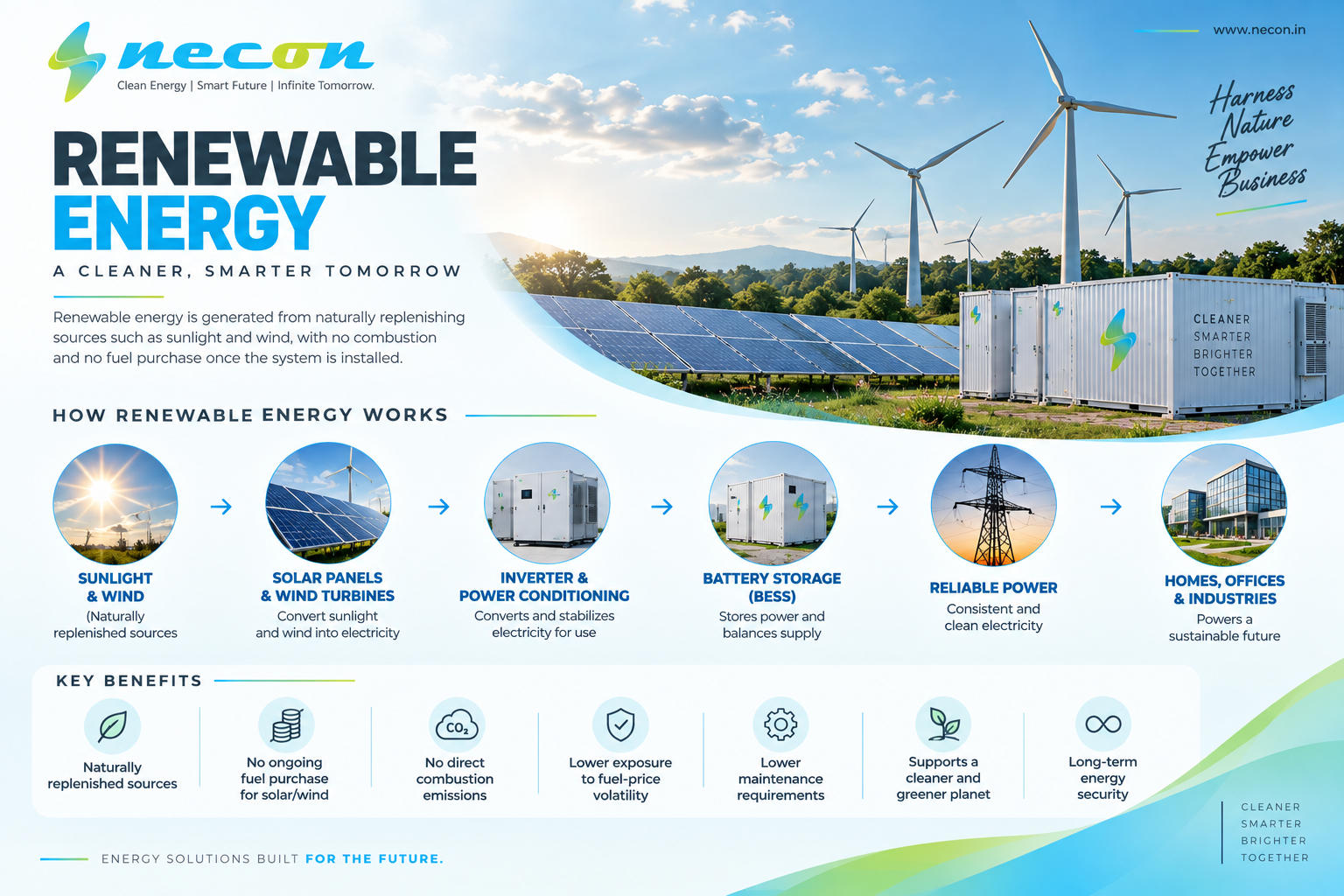
Renewable energy is electricity generated from naturally replenishing sources such as sunlight, wind, water, or biomass, none of which deplete with use. Solar photovoltaic (PV) panels convert sunlight directly into electricity using semiconductor cells. Wind turbines convert moving air into rotational energy that a generator turns into electricity. Both processes involve no combustion and no fuel purchase once the system is installed.
The two dominant commercial technologies are solar and wind:
Solar power offers high energy yield in daylight hours and is modular and quick to deploy, but generation drops to zero after sunset and dips in heavy cloud cover.
Wind power can generate at night and in most weather conditions, complementing solar's daytime-only output. NECON's vertical axis wind turbines are built specifically to keep generating in lower and turbulent wind conditions, where conventional horizontal-axis turbines lose efficiency.
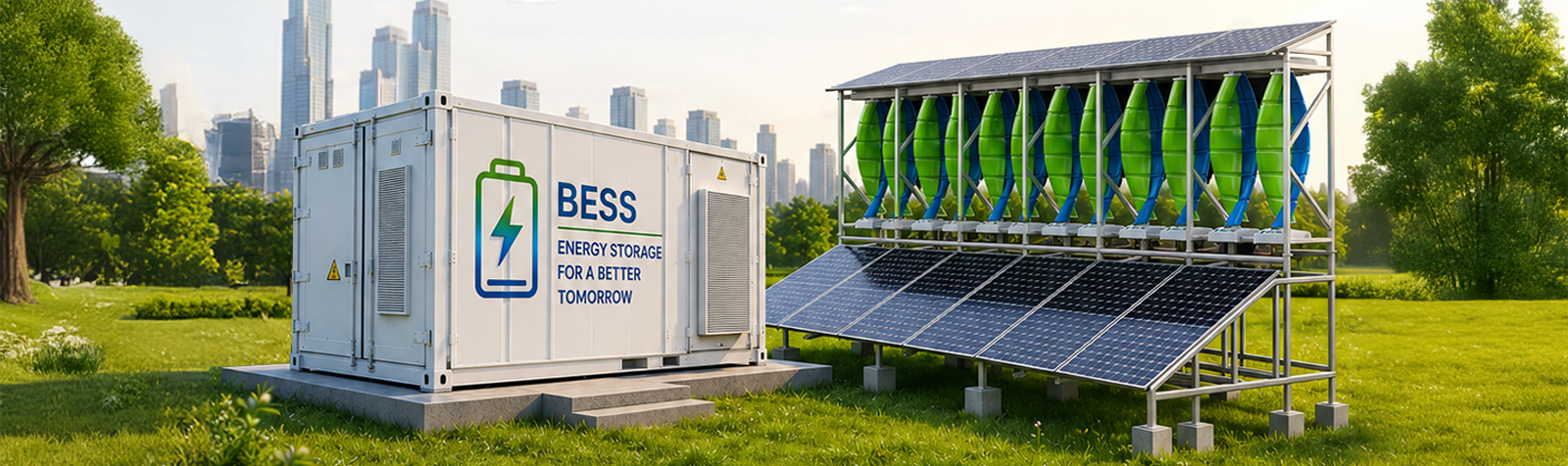
Combined intelligently, with solar running by day, wind filling in around it, and battery storage smoothing the gaps, renewable sources stop being "intermittent" and start behaving like a genuine round-the-clock power source. That combination is what NECON calls a hybrid power park.
Renewable Energy vs Traditional Power: Quick Comparison
Factor | Traditional Power | Renewable Energy |
Energy source | Coal, gas, diesel, oil (finite) | Sunlight, wind, water (inexhaustible) |
Emissions | High: CO2, SOx, particulates | Near-zero during operation |
Fuel cost | Ongoing, rises with market inflation | None, the "fuel" is free |
Supply | Depends on extraction and imports | Naturally replenished every day |
Maintenance | Generally higher mechanical and thermal-system maintenance | Generally lower routine maintenance for solar and wind |
Cost trend | Exposed to fuel, operating, and market costs | Less exposed to fuel-price volatility after installation |
Reliability | Weather-independent, but fuel- and grid-dependent | Weather-dependent alone; hybrid plus storage closes the gap |
Land and water use | Heavy water use for cooling | Minimal water use |
Burns Fuel vs Uses Sun and Wind
Every unit of traditional electricity starts with combustion. That process is where pollution, ash, and greenhouse gases originate, not from the electricity itself, but from how it's made. Renewable systems skip that step entirely. Solar panels and wind turbines convert energy that's already present in the environment, with no burning and no direct emissions during operation. This is the single biggest reason renewable energy has become central to corporate sustainability and net-zero commitments. NECON's breakdown of how renewable energy reduces carbon footprint covers the mechanics in more detail.
Limited Supply vs Unlimited Supply
Coal, gas, and oil are extracted, not generated. Every tonne burned is a tonne gone, and reserves are finite by definition. Sunlight and wind, on the other hand, are replenished daily by natural processes that aren't going anywhere. This is what "renewable" technically means: not that the equipment lasts forever, but that the source it draws from does. For a business, this translates directly into supply security, with no dependence on coal linkage, gas import contracts, or diesel logistics.
Rising Costs vs Stable Costs
Traditional power has a lower barrier to entry. You don't need to invest in generation equipment, you simply pay for what you use. But that convenience comes at a price that keeps climbing, because fuel, transport, and distribution costs all get passed through to the tariff. Renewable energy flips this structure: a higher upfront investment is followed by years of near-zero marginal generation cost, since sunlight and wind don't carry a fuel bill. For commercial and industrial (C&I) consumers, open-access solar and wind PPAs can offer lower long-term electricity costs than conventional grid power, depending on tariffs, financing, regulations, location, and contract structure. Because sunlight and wind have no fuel purchase cost, the price mainly reflects equipment, financing, transmission or wheeling charges where applicable, and maintenance rather than fuel inflation.
Is Renewable Energy Actually Reliable?
This is the one objection that comes up in almost every renewable-vs-traditional comparison, and it's the one competing articles rarely resolve. Solar alone generates only in daylight. Wind alone varies with weather patterns. Judged individually, either source looks less dependable than a thermal plant that can run continuously.
That isn't how modern renewable infrastructure is actually built, though. Three things close the reliability gap:
Pairing solar with wind means one source is often generating when the other isn't. Solar peaks in the day, and wind can pick up at night or during monsoon cloud cover. NECON's hybrid power parks are designed around this complementary generation profile to deliver higher, steadier output from the same land footprint.
Battery Energy Storage Systems (BESS). Storing surplus daytime generation for use after sunset turns a variable resource into a dispatchable one. NECON's guide to Battery Energy Storage Systems explains how this works in practice.
Grid or hybrid configuration. Systems can be grid-connected, fully off-grid, or hybrid, depending on how much independence a site needs. The difference is explained in Grid-Connected vs Off-Grid Solar Systems.
Put together, a well-designed hybrid renewable system with storage can provide much more dependable power than standalone solar or wind. Whether it can match the uptime of a traditional plant depends on system design, storage duration, grid configuration, resource availability, and the site's reliability requirements.
Environmental Impact
Traditional thermal power is a major source of greenhouse gas emissions and air pollution, and many thermal plants also use significant amounts of water for cooling. Solar and wind generation produces no direct combustion emissions during operation and generally uses much less water during generation. Manufacturing solar panels and wind turbines does carry an upfront carbon footprint, while their overall lifecycle emissions remain far lower than those of fossil-fuel generation. After installation, solar and wind generate electricity without direct combustion emissions throughout their operating life.
Which One Should Your Business Choose?
For most commercial and industrial consumers today, the decision isn't strictly binary. It's about how much of your load you shift, and how. Use this as a starting checklist:
High, steady daytime load (factories, warehouses, cold storage): solar or hybrid solar-wind can offset a large share of grid dependence.
Round-the-clock operations (data centers, continuous-process manufacturing): a hybrid power park with BESS is built for exactly this profile.
Unreliable grid supply or frequent outages: off-grid or hybrid configurations reduce dependence on DISCOM uptime.
Sustainability or net-zero targets: renewable adoption is one of the fastest, most measurable ways to cut Scope 2 emissions. See Top 10 Benefits of Switching to Green Energy and Renewable Energy's Role in Achieving Net Zero.
Long-term budget certainty: locking in a fixed-cost PPA or captive renewable asset insulates you from future fuel-driven tariff hikes.
The Real Difference: Same Electricity, Different Source
Traditional power and renewable energy deliver the same usable electricity. The difference is in the source, the cost exposure, and the emissions associated with generation. Traditional power generally relies on fuels that are finite and subject to fuel-price and supply risks. Renewable energy, especially when built as a hybrid solar-wind system with battery storage, uses naturally replenished resources and can provide more predictable power when properly designed.
If you're evaluating a shift from traditional grid power to a renewable setup for your business, explore NECON's Solar Power Parks, Hybrid Power Parks, and Sustainability approach, or get in touch to talk through what a hybrid, round-the-clock clean power system would look like for your site.
Frequently Asked Questions
Is renewable energy really cheaper than traditional power?
Renewable energy can be cheaper over the life of a system because solar and wind have no ongoing fuel purchase cost. However, actual savings depend on technology, financing, location, electricity tariffs, system design, and regulatory conditions.
What is the main difference between renewable and traditional power?
The main difference is how the electricity is generated. Traditional power generally relies on finite fuels such as coal and natural gas, while renewable power uses naturally replenished sources such as sunlight and wind, with no fuel purchase for solar or wind generation and no direct combustion emissions during operation.
Is renewable energy reliable enough to replace traditional power completely?
Standalone solar or wind has intermittency limits, but hybrid systems that combine solar, wind, and battery storage can provide more dependable power across the day. The achievable reliability depends on resource availability, storage capacity, system design, and whether the system remains connected to the grid.
Why is traditional power still used if renewable energy is cleaner and cheaper long-term?
Traditional power benefits from established infrastructure and dispatchable generation. Renewable energy can require significant upfront investment and, for variable sources, additional storage or grid support, which is why hybrid and storage-backed systems can play an important role in a broader transition.
Does switching to renewable energy require replacing existing electrical equipment?
Not necessarily. Renewable systems can supply the same type of electrical power used by standard appliances and machinery, but a project may require inverters, transformers, protection equipment, metering, controls, or other electrical-system upgrades depending on its configuration.
How does a hybrid wind-solar system compare to solar alone?
A hybrid wind-solar system generates more consistently across the day and across seasons, because wind and solar output patterns often complement each other, while solar alone stops producing after sunset and dips heavily in cloudy or monsoon conditions.