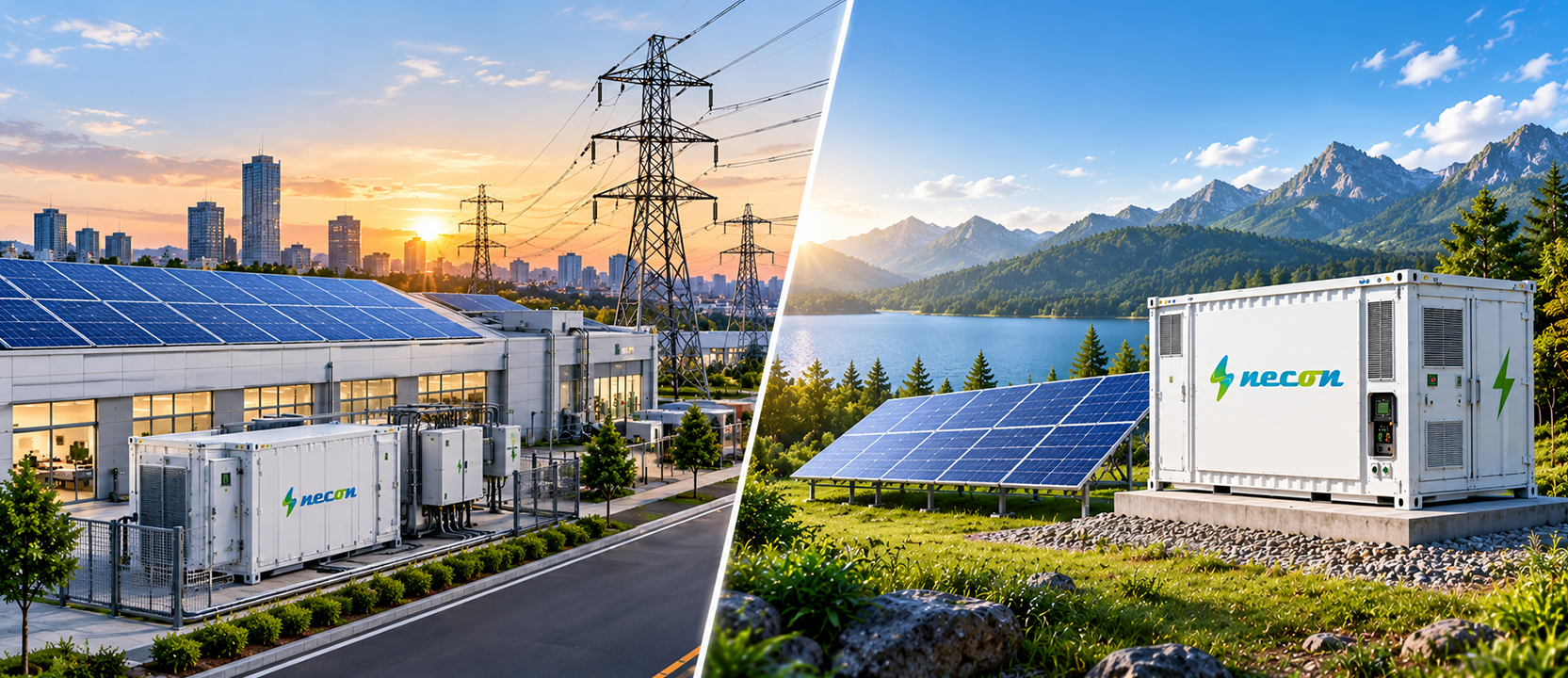
A solar inverter converts the DC electricity made by solar panels into AC, the form used by appliances and the grid. In India, that usually means 230 V single-phase or 400/415 V three-phase at 50 Hz. It also tracks the panels' best operating point, monitors performance and disconnects safely if the grid fails.
The exact output and grid connection depend on the project design. Utility-scale plants, for example, often use transformers to step inverter output up to the required grid voltage.
Think of solar panels as the engine of a solar plant and the inverter as its gearbox and brain. Panels can generate plenty of energy, but most AC appliances, industrial loads and the grid cannot use panel output directly. At NECON, we design and build solar power parks and hybrid plants, and the inverter is one of the key components that decides how effectively solar energy reaches the system.
Solar Inverters at a Glance
Solar panels produce DC. Most buildings and the grid use AC. The inverter connects the two.
A 50 Hz AC waveform changes polarity 100 times per second. The inverter's power switches work at much higher frequencies to build that waveform.
Many modern grid-tied inverters reach peak efficiencies in the high 90% range.
Beyond conversion, inverters handle MPPT, grid synchronisation, protection and monitoring.
In India, solar inverters fall under mandatory BIS requirements, with standards that vary by inverter category and capacity.
Why Do Solar Panels Make DC When Buildings Need AC?
Solar panels produce direct current because the photovoltaic effect pushes current in one direction at the module terminals. That one-way flow is called DC.
Buildings on the Indian grid receive alternating current. The grid runs at 50 Hz, so the AC waveform completes 50 cycles every second and changes polarity twice in each cycle. Power networks use AC because transformers can easily change its voltage for transmission and distribution.
Most appliances, motors and industrial controls are built for AC, so a solar inverter must convert panel output before it can run these loads or feed the grid. Batteries and compatible DC equipment can use DC directly in a suitably designed system.
Even high-efficiency panels, such as NECON's N-type TOPCon bifacial modules rated at up to 22.80% efficiency, need an inverter before their energy can supply AC loads. Read more about how NECON manufactures solar modules in-house.
How Does a Solar Inverter Convert DC to AC?
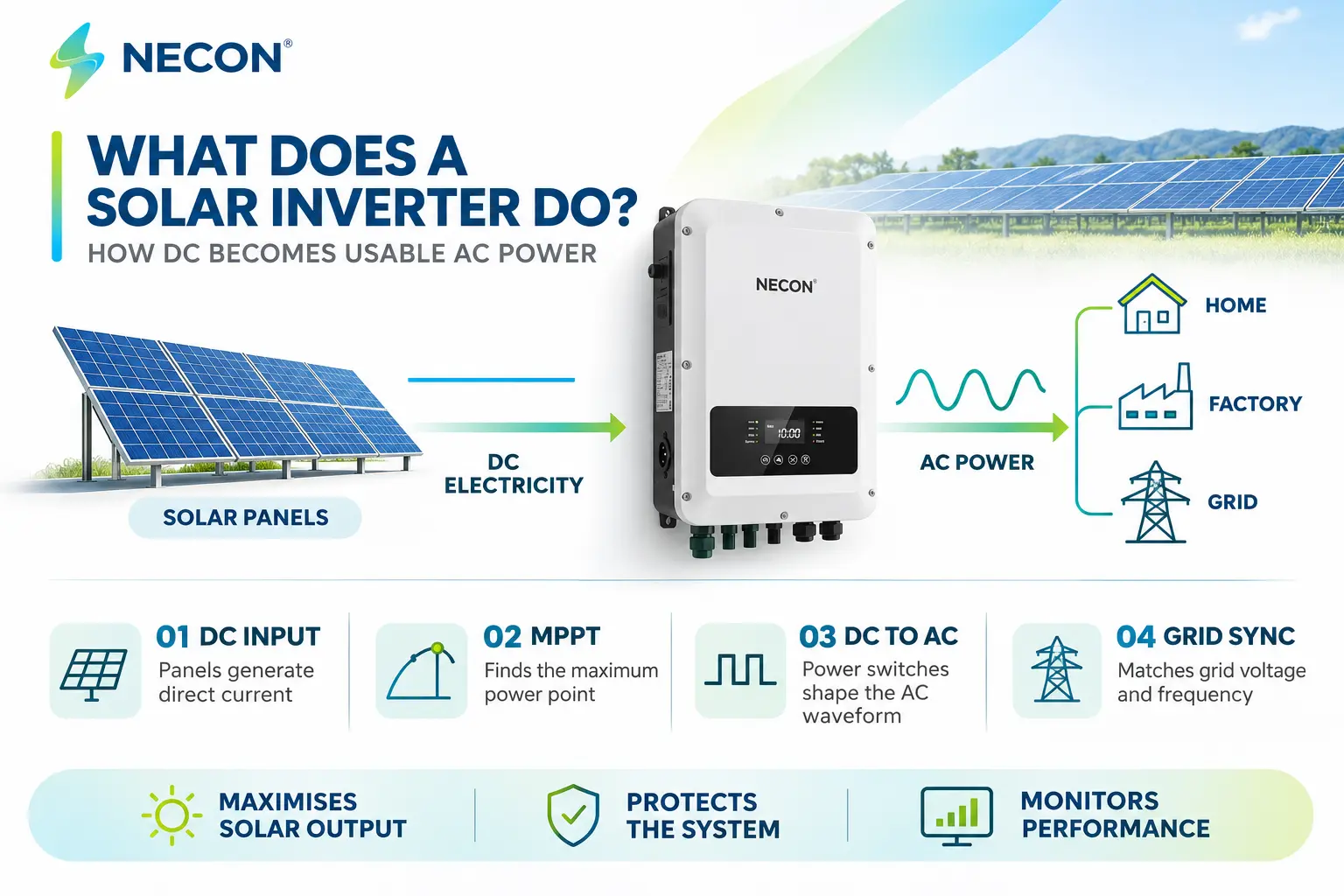
A solar inverter converts DC to AC by switching semiconductor devices on and off in a controlled pattern, then filtering the pulses into a smooth AC waveform. Here is the process in simple steps:
DC enters the inverter: Panels connected in series, called strings, supply DC to the inverter. Rooftop strings typically run at several hundred volts DC, while many utility-scale systems are designed for up to 1,500 V DC.
MPPT finds the best operating point: The Maximum Power Point Tracker adjusts the panels' operating point to capture the most power as sunlight, temperature and shading change.
The DC link stabilises the supply: Capacitors in the DC link hold the voltage steady for the switching stage.
Power switches build the waveform: Semiconductor devices such as IGBTs or MOSFETs, often arranged in bridge circuits like an H-bridge, switch at high frequency. Pulse-width modulation (PWM) shapes the pulses so their combined output follows an AC waveform.
Filters smooth the output: Inductors and capacitors remove switching noise and produce a smooth sine wave. Some designs add a transformer for voltage conversion or electrical isolation.
The inverter synchronises or sets the AC: A grid-connected inverter matches the grid's voltage, frequency and phase before exporting power. An off-grid inverter has no grid to follow, so it sets the voltage and frequency for its own local supply.
A simple way to picture AC: traffic moving one way, then the other, in a steady repeating rhythm. The smooth waveform shows how voltage and current rise and fall in each cycle.
What Else Does a Solar Inverter Do?
A solar inverter does more than convert power. It acts as the control and protection centre of the solar system.
Maximum power point tracking (MPPT): adjusts the panels' operating point to capture the most power as sunlight and temperature change.
Grid synchronisation: matches the grid's voltage, frequency and phase before exporting power, typically at 230 V single-phase or 400/415 V three-phase.
Anti-islanding protection: disconnects the inverter when the grid fails, so it cannot energise lines that utility workers believe are dead.
Fault protection: detects earth faults, over-voltage, over-temperature and insulation problems, and responds to protect the system.
Monitoring and data: records generation, operating conditions, alarms and faults so owners and Operations and Maintenance (O&M) teams can spot issues early.
Grid support at utility scale: inverters built for grid support can supply or absorb reactive power and help steady voltage during disturbances, as the grid code requires.
What Are the Main Types of Solar Inverters?
The right inverter type depends on plant size, shading, system design and whether you need backup power. Capacities below are indicative and vary by manufacturer.
Inverter type | Indicative size | Best for | Key strength | Trade-off |
|---|---|---|---|---|
Microinverter | A few hundred watts per module | Small rooftops with mixed shading or orientations | Panel-level conversion and monitoring | Higher cost per watt |
String inverter | A few kW to several hundred kW | Homes, commercial and industrial (C&I) rooftops, many utility projects | Flexible design, easy replacement | More units to manage at large sites |
Central inverter | Around 1 MW to 5 MW or more | Large solar power parks | Economies of scale | A fault affects a larger block of capacity |
Hybrid inverter | Residential to commercial sizes; large projects use separate power conversion systems | Sites combining solar, battery and grid | Coordinates solar, battery and grid in one system | Higher upfront cost and more design work |
Off-grid inverter | Small kW systems to larger projects | Remote sites with no grid connection | Creates an independent AC supply | Needs carefully sized generation and storage |
If you are deciding between a system with or without a grid connection, read our guide to grid-connected vs off-grid solar systems. For sites that need storage, see how batteries store extra solar and wind power.
How Efficient Is a Solar Inverter?
Many modern grid-tied inverters reach peak efficiencies in the high 90% range, and some approach 99% under good conditions. The rest is lost mainly as heat. The exact figure depends on the model, load, DC voltage and temperature, so always check the datasheet.
Two terms matter when comparing models:
Peak efficiency is the highest efficiency a model achieves under specified test conditions.
Weighted efficiency, such as European or California Energy Commission (CEC) efficiency, averages performance across several load levels. It gives a fairer comparison when the same method is used.
Heat matters. In high ambient temperatures, many inverters reduce output to protect their components, a process called derating. Install inverters where they meet the manufacturer's ventilation and clearance requirements, and for Indian conditions check the operating-temperature range and derating curve.
What Is the DC to AC Ratio, and Why Does It Matter?
The DC to AC ratio compares the solar array's rated DC capacity with the inverter's rated AC output. A 1.3 MWp array on a 1 MW inverter has a ratio of 1.3.
Panels rarely produce their full rating, because output changes with sunlight, temperature, orientation and soiling. Designers therefore often install more DC capacity than the inverter's AC rating. Utility-scale projects commonly use ratios around 1.2 to 1.4, though there is no universal figure.
A higher ratio keeps the inverter near full output for more hours. The trade-off is clipping: when the array could produce more than the inverter can convert, output is capped at the inverter's AC rating. The right ratio balances extra morning and evening generation against clipping, equipment cost, solar tracker configuration and grid-export limits. A yield simulation should guide the final design.
Which Indian Standards Apply to Solar Inverters?
India's Solar Systems, Devices and Components Goods Order, 2025 brings specified solar products, including inverter categories, under the Bureau of Indian Standards (BIS) framework. The applicable standards depend on the product category, so not every inverter faces an identical set of requirements.
The standards listed for the main inverter categories include:
IS 16221 (Part 2):2015: safety requirements for inverters used in photovoltaic power systems.
IS/IEC 61683:1999: procedure for measuring the efficiency of photovoltaic power conditioners, listed for power inverters used in PV systems.
IS 16169:2019: test procedure for islanding-prevention measures in utility-interconnected PV inverters.
IS 17980:2022: measurement of static and dynamic maximum power point tracking (MPPT) efficiency for grid-connected PV inverters.
There is also a time-bound transition for high-capacity products. As of 5 November 2026, implementation of the 2025 Order for specified SPV inverter categories above 200 kW has been extended until 31 December 2026, or until further orders, whichever is earlier. During this period, self-certification is allowed only for manufacturers holding valid IEC certificates for the applicable Indian Standards and test reports from accredited laboratories. It is a limited provision, not a blanket exemption.
Before procurement, ask the manufacturer or EPC partner for the BIS licence or registration details, and where the transition applies, the IEC certificates and accredited lab reports. Read the official Gazette notification S.O. 3706(E) for the current extension, and check the BIS product certification pages for later updates.
How Do Inverters Work in Hybrid Power Parks?
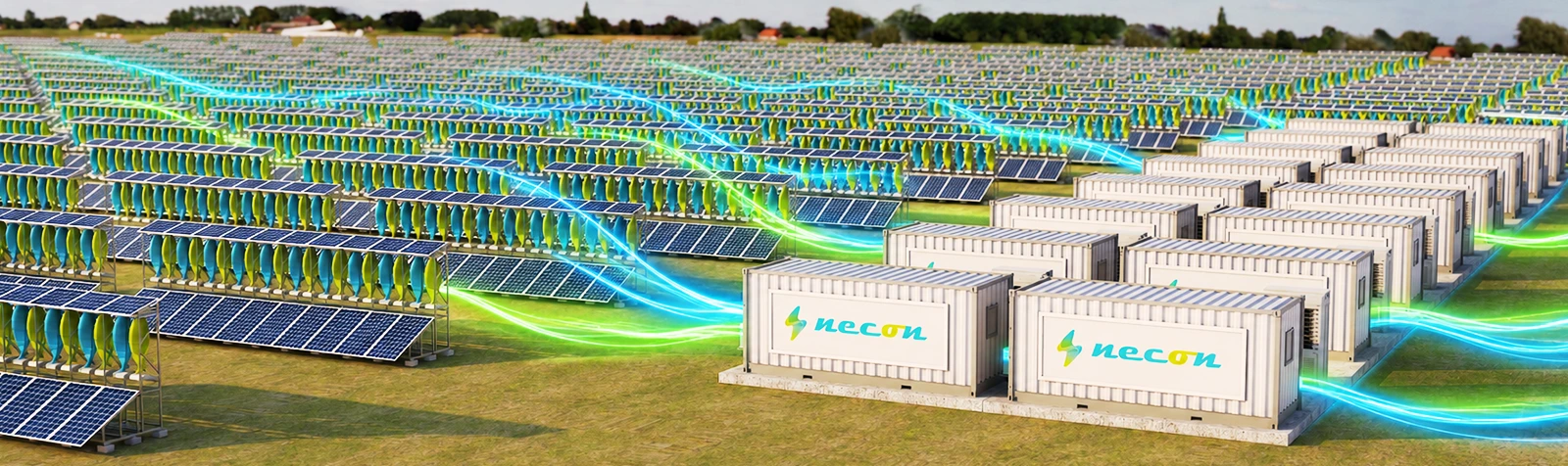
In a hybrid power park, power converters let solar, wind and battery systems feed a shared electrical network or grid connection.
At NECON's hybrid power parks, solar inverters convert panel output, vertical axis wind turbines use their own power converters, and bidirectional inverters, often called power conversion systems (PCS), manage Battery Energy Storage Systems (BESS). Batteries charge from surplus daytime generation and discharge when generation falls or demand rises. A plant controller coordinates every unit to meet the plant's operating and grid requirements.
This is how solar, wind and storage work together to deliver a steadier, more controlled power profile. Learn more about hybrid renewable energy and how it works.
How to Choose the Right Solar Inverter
Choose an inverter by matching it to your load, site and grid connection, not by price alone.
Match capacity to the array: Select a DC to AC ratio based on a yield simulation.
Choose the right architecture: Consider plant size, shading, module layout, battery needs and grid connection.
Compare efficiency fairly: Check weighted efficiency as well as peak efficiency, using the same method.
Verify standards and documents: Confirm BIS compliance, certificates and high-temperature operating limits.
Review MPPT channels: Multiple MPPT inputs help when strings face different directions or shading.
Check monitoring and support: Review data access, warranty terms, service coverage and response times.
Why the Right Inverter Matters
A solar inverter is the bridge between solar panel output and usable AC power. It converts DC to AC, keeps panels at their maximum power point, manages grid interaction, provides protection and reports performance. Choosing the right inverter protects the output and long-term value of every solar installation.
Planning a solar power park, C&I rooftop system or hybrid plant? Explore NECON's solar power solutions and talk to NECON's engineering team about an integrated design that brings solar, wind and storage together.
Frequently Asked Questions
Can solar panels work without an inverter?
Solar panels can supply compatible DC equipment directly when the system has the right voltage controls and protection, and a charge controller can regulate power into a battery. However, most home and factory appliances run on AC. To operate those loads or export electricity to the grid, you need a suitable inverter.
Does a solar inverter work during a power cut?
A standard grid-connected inverter disconnects during a power cut because of anti-islanding protection, which keeps utility workers safe. A hybrid or off-grid system can keep selected loads running during an outage, but only with a suitable battery, a backup-capable inverter and correctly designed backup wiring.
How efficient is a solar inverter?
Many modern grid-tied solar inverters reach peak efficiencies in the high 90% range, and some approach 99% under good conditions. Real performance varies with load, DC voltage and temperature. When comparing models, check weighted efficiency measured by the same method, along with the manufacturer's derating data.
What is the difference between a solar inverter and a normal inverter?
A normal home inverter stores grid electricity in a battery and converts the battery's DC back to AC during an outage. A solar inverter converts power from solar panels and uses MPPT to capture as much generation as possible. A hybrid inverter can coordinate solar, batteries and the grid together.
How long does a solar inverter last?
A solar inverter's life depends on its design, operating temperature, installation environment and maintenance. Around 10 to 15 years is a common planning estimate, but it is not guaranteed for every model. Check the manufacturer's warranty, service conditions and replacement support before you buy.
Why do solar inverters shut down when the grid fails?
Grid-connected inverters disconnect when the utility supply fails to prevent unintentional islanding. Without this protection, a solar system could keep energising part of the network that utility workers believe is switched off. In India, anti-islanding performance is tested under IS 16169:2019 for utility-interconnected photovoltaic inverters.
What size solar inverter do I need?
Inverter size depends on your array's DC capacity, expected generation, site conditions, load profile, grid-export limits and acceptable clipping. Rooftop and utility projects use different DC to AC ratios, so no single ratio suits every site. Ask your EPC partner for a design backed by a yield simulation.