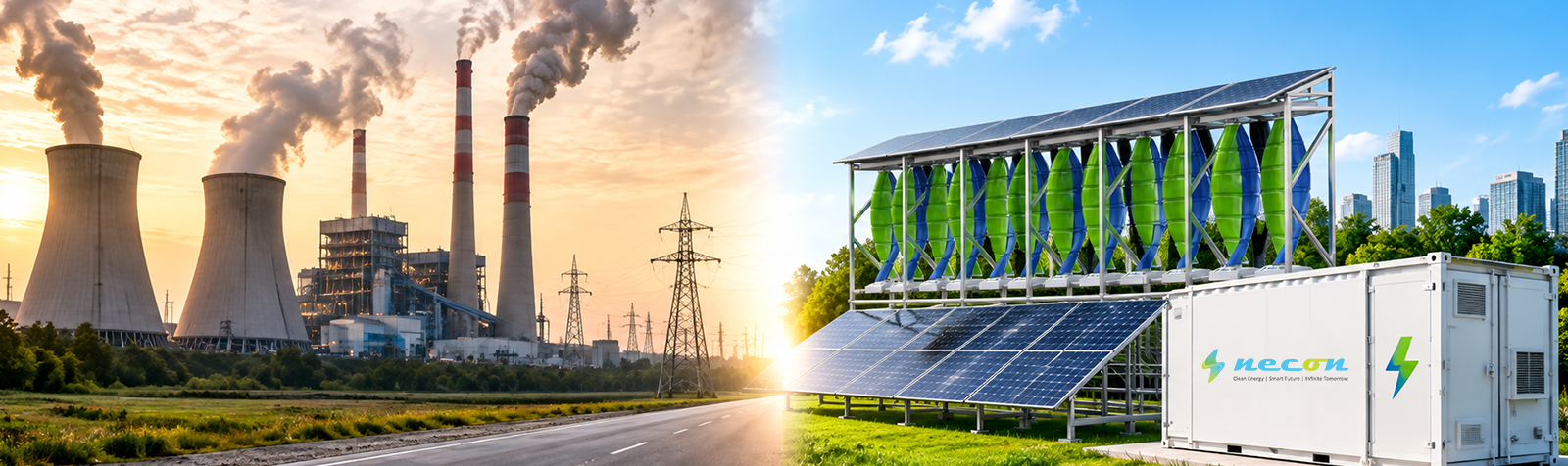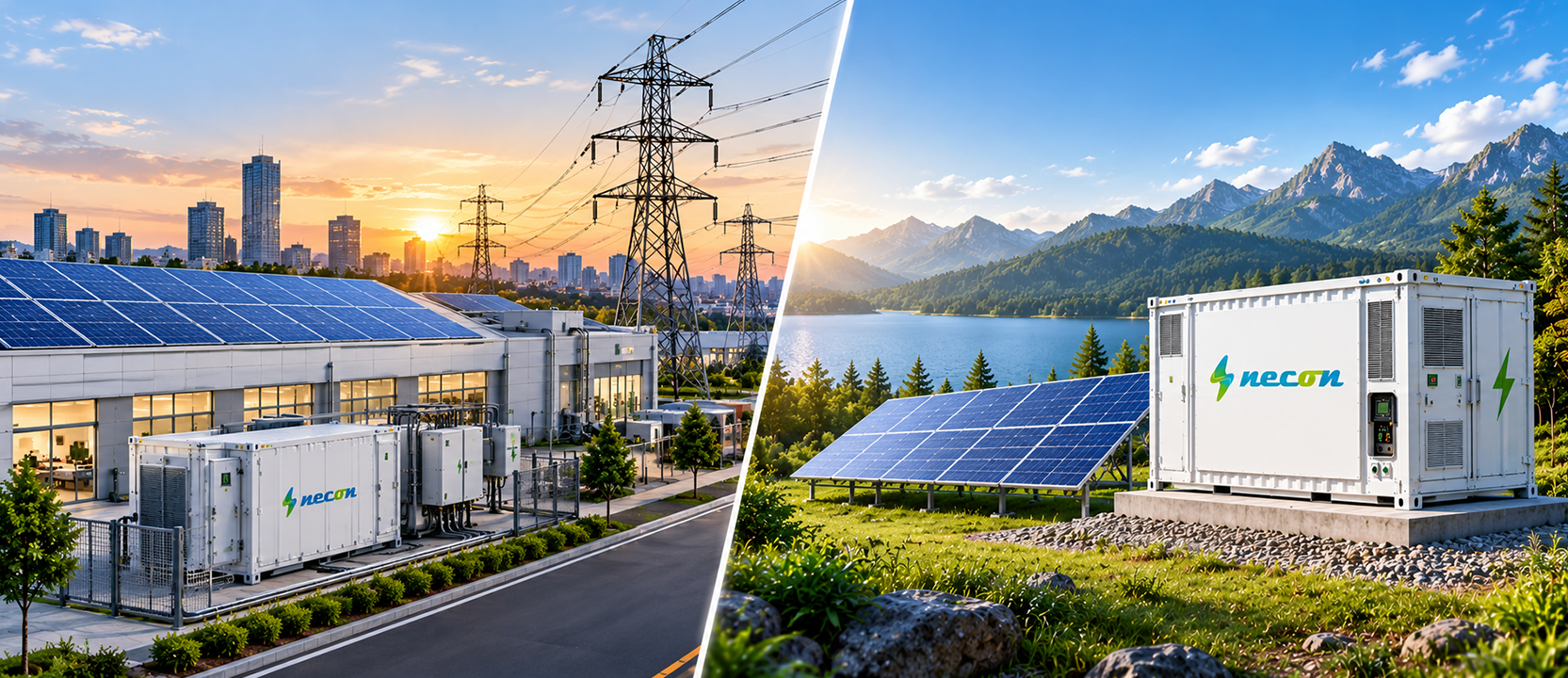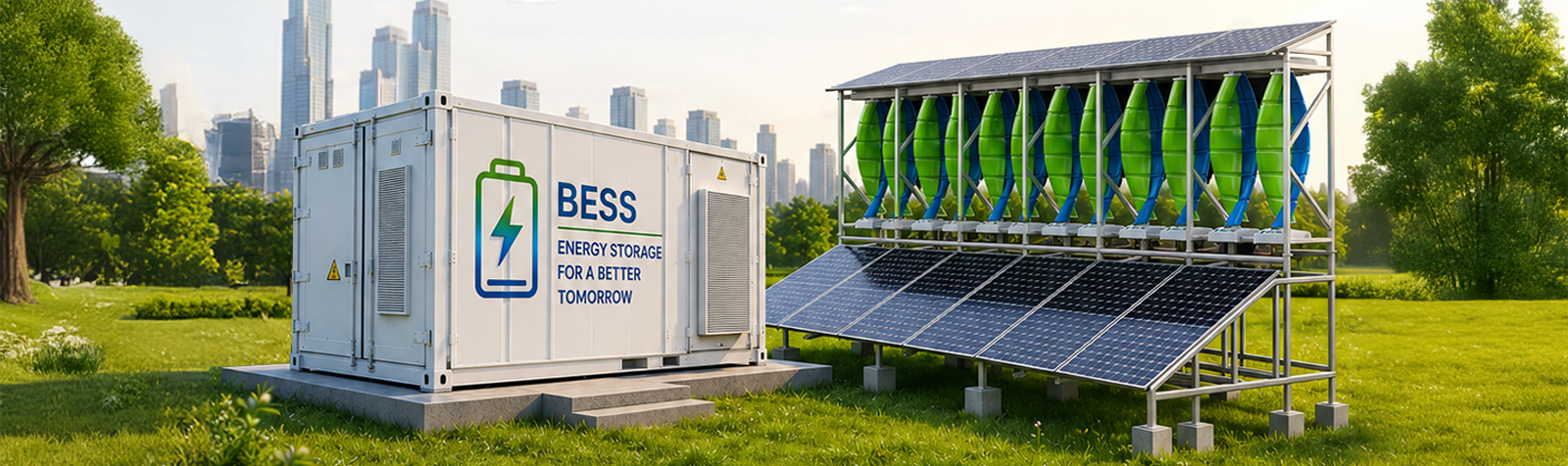
As businesses, industries, and governments accelerate the transition to renewable energy, distributed power generation is becoming an essential part of modern energy infrastructure. Instead of relying solely on large utility-scale wind farms, organizations are increasingly looking for compact and efficient renewable energy solutions that can generate electricity closer to where it is consumed.
Vertical Axis Wind Turbines (VAWTs) are playing an important role in this transformation. Unlike traditional Horizontal Axis Wind Turbines (HAWTs), which require large open spaces and must continuously face the wind, VAWTs capture wind from any direction without repositioning. This unique capability makes them an ideal solution for commercial rooftops, telecom towers, industrial facilities, educational campuses, and off-grid renewable energy projects where conventional wind turbines may not be practical.
At NECON, we develop innovative Vertical Axis Wind Turbine solutions as part of a comprehensive hybrid renewable energy approach. By integrating wind power with solar energy and battery storage, we help businesses generate reliable clean electricity while improving energy independence and reducing carbon emissions.
The renewable energy sector is rapidly shifting toward distributed energy systems, where electricity is generated closer to the point of consumption rather than relying entirely on centralized power plants. This approach reduces transmission losses, improves energy resilience, and allows businesses to make better use of available rooftop or site infrastructure.
Vertical Axis Wind Turbines have become increasingly popular because they are designed to perform efficiently in locations where traditional wind turbines struggle.
Key advantages include:
Operate efficiently regardless of wind direction
Perform well in turbulent urban wind conditions
Require less installation space than conventional wind turbines
Produce lower operating noise
Simplify maintenance with easily accessible components
Integrate seamlessly with solar photovoltaic systems and battery energy storage
These benefits make VAWTs an excellent solution for:
Commercial buildings
Industrial facilities
Warehouses and logistics parks
Telecom and communication towers
Defence and border installations
Educational campuses
Smart city infrastructure
Remote and off-grid renewable energy projects
As businesses continue investing in sustainable infrastructure, Vertical Axis Wind Turbines are helping bridge the gap between conventional power generation and intelligent hybrid renewable energy systems.
A Vertical Axis Wind Turbine (VAWT) has a vertical rotor shaft that allows its blades to rotate around a central axis regardless of wind direction. Unlike Horizontal Axis Wind Turbines, which require a yaw mechanism to continually align with the wind, VAWTs naturally capture wind from every direction without repositioning.
This omnidirectional capability makes Vertical Axis Wind Turbines especially practical in environments where wind direction changes frequently, such as dense urban areas with turbulent airflow between buildings or remote locations where wind patterns are less predictable.
The two most common VAWT designs are Savonius and Darrieus, each using a different aerodynamic principle to generate electricity.
Feature | Savonius | Darrieus |
|---|---|---|
Operating Principle | Drag-based; cup or scoop-shaped blades push against the wind | Lift-based; curved airfoil blades generate lift similar to an aircraft wing |
Best For | Low wind speeds, residential applications, and small-scale installations | Higher efficiency at moderate-to-high wind speeds and commercial installations |
Typical Efficiency | Lower (drag-limited) | Higher (lift-based aerodynamics) |
Start-up Torque | Higher; starts rotating easily in light wind | Lower; some designs may require assisted start |
Common Applications | Residential rooftops, ornamental systems, hybrid installations | Commercial rooftops, telecom towers, distributed renewable energy projects |
Most commercial-grade VAWTs, including NECON's VertX 1000-2VX, use lift-based blade profiles refined through CFD modeling and wind tunnel testing to balance efficiency with structural durability.
Generic claims about wind turbines being "efficient" don't mean much without specifics. Here's what a current-generation unit looks like in practice, using NECON's VertX 1000-2VX as a reference point:
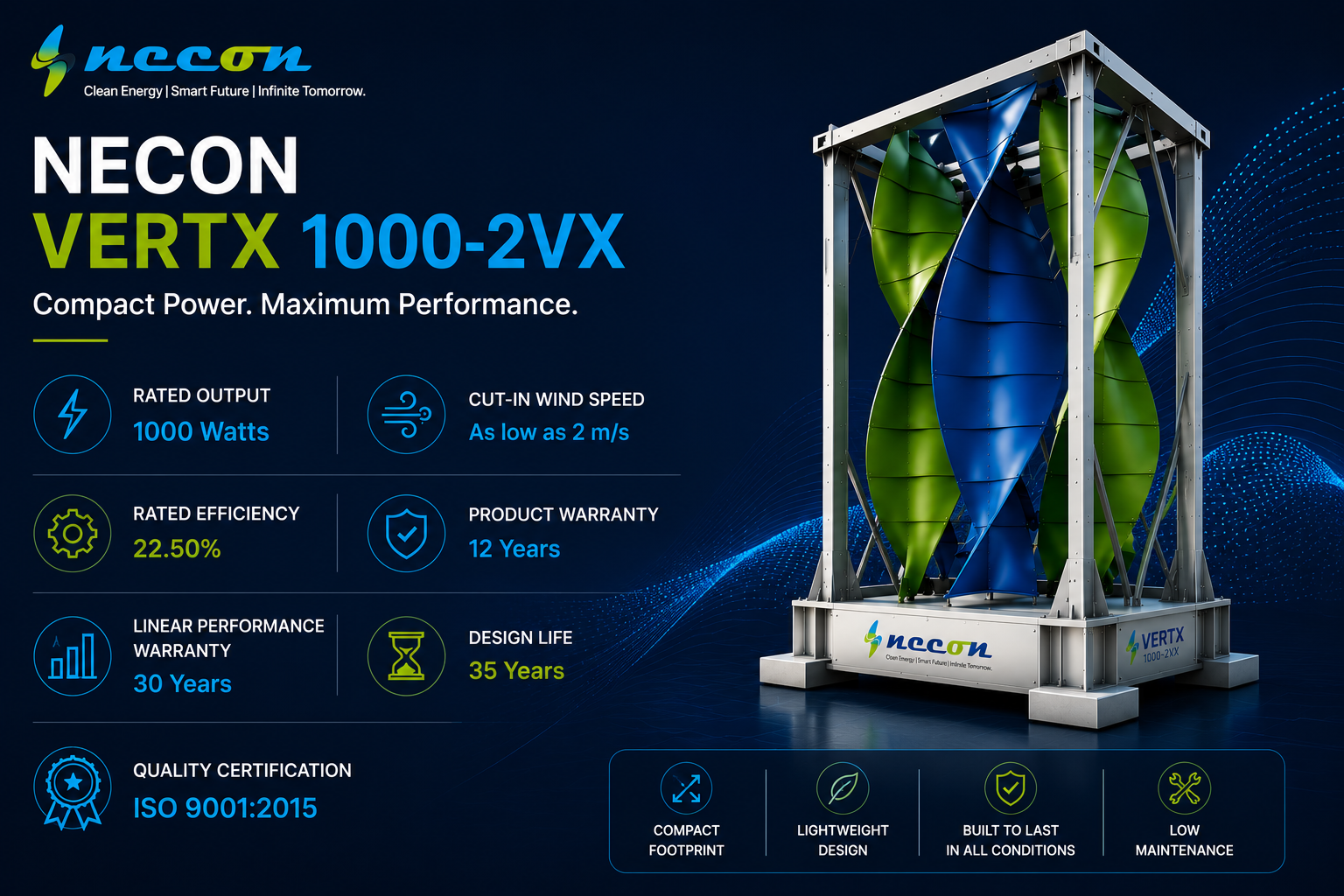
Rated output: 1,000 watts
Rated efficiency: 22.50%
Cut-in wind speed: as low as 2 m/s, meaning it starts generating in conditions where a horizontal turbine would remain idle
Power tolerance: -0% / +4.99%, so output doesn't fall short of spec
Product warranty: 12 years on materials and workmanship
Linear performance warranty: 30 years
Design life: 35 years
Quality certification: ISO 9001:2015
That low cut-in speed matters more than it might seem. It's the difference between a turbine that only earns its keep on windy days and one that contributes to the energy mix most of the year, including in low-wind regions that were previously written off for wind power entirely.
Learn more about the NECON VertX 1000-2VX, including detailed technical specifications, installation options, and hybrid renewable energy applications.
VAWTs aren't a lab curiosity. They're already solving specific power problems:
Office buildings, shopping centres, warehouses, hotels, and commercial complexes are adopting rooftop Vertical Axis Wind Turbines to generate clean electricity without requiring the large land footprint associated with conventional wind farms.
When combined with rooftop solar photovoltaic systems, VAWTs help reduce electricity costs while improving overall energy resilience.
Telecom infrastructure often operates in locations where grid reliability is limited. Vertical Axis Wind Turbines integrated with solar panels and battery storage provide a dependable hybrid power solution that reduces diesel generator dependency, lowers operating costs, and minimizes carbon emissions.
Military bases, border infrastructure, and high-altitude installations require reliable power with minimal maintenance. The compact design and durable construction of Vertical Axis Wind Turbines make them well suited for these demanding environments where reliability is more important than maximum power output.
Remote villages, agricultural facilities, research stations, mining sites, and island communities can benefit from Vertical Axis Wind Turbines as part of standalone or hybrid renewable energy systems. Their ability to generate electricity in changing wind conditions helps improve energy availability where grid access is limited or unavailable.
See the full breakdown of these use cases and technical specifications on the Vertical Axis Windmill product.
Three practical factors explain why VAWTs are gaining ground in cities and hybrid installations specifically:
Compact footprint. The vertical design achieves higher power density per square meter than a horizontal turbine of comparable output, which matters when the available space is a rooftop, not a wind farm.
Lower noise and visual profile. Fewer moving parts and a streamlined vertical structure mean quieter operation, a real constraint for residential and commercial sites where a large spinning horizontal blade isn't an option.
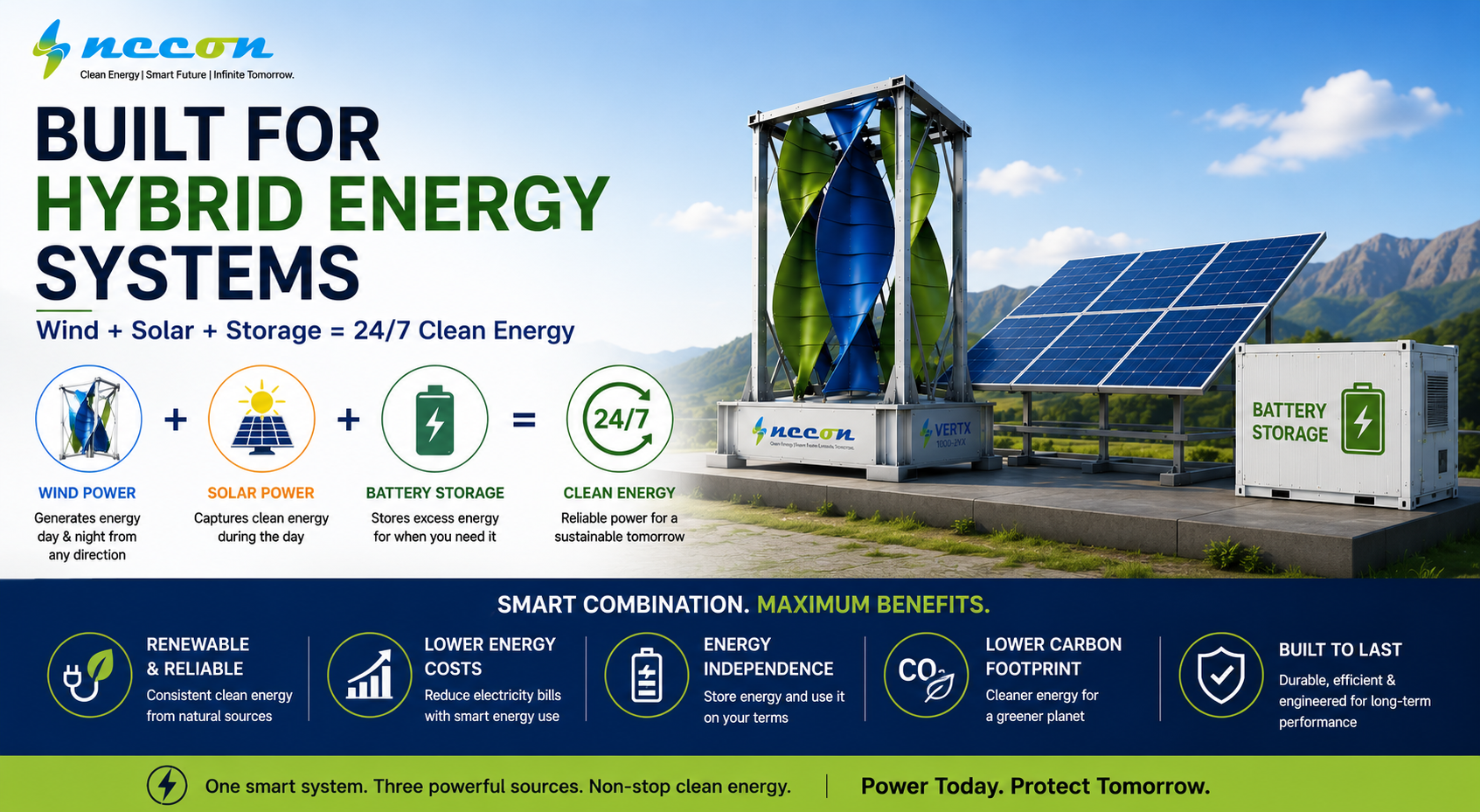
Built for hybrid integration. VAWTs are increasingly engineered from the start to work alongside solar panels and battery storage, so a site gets power when the sun isn't out and when the wind isn't blowing, not just one or the other. Explore how this comes together in practice on our Hybrid Power Parks.
Fewer moving parts also means less maintenance traffic to the site and lower mortality risk to birds and bats compared to fast-moving horizontal blades, since VAWTs typically operate at lower tip speeds and closer to the ground. Combined with a smaller land footprint, this is part of why VAWTs are increasingly factored into sustainability and ESG planning rather than treated as a niche alternative. Read more about how this fits into a broader sustainability strategy on our Sustainability page.
Vertical axis windmills aren't a replacement for utility-scale wind farms. They're a complement, filling in the gaps horizontal turbines can't reach: rooftops, telecom infrastructure, defence sites, and off-grid locations where space, noise, and low wind speed rule out conventional turbines. Paired with solar and storage in a hybrid setup, they're part of how distributed, round-the-clock renewable power actually gets built.
If you're evaluating a vertical axis wind turbine for a commercial, industrial, or off-grid project, get in touch with NECON's team to discuss site assessment and system design, or explore our full range of hybrid energy solutions.
A VAWT is a wind turbine with a vertical rotor shaft, allowing it to capture wind from any direction without needing to reposition. This makes it well-suited to urban sites and locations with variable wind direction.
Neither is universally "better." They solve different problems. Horizontal turbines generally deliver higher output at scale in open, consistent-wind locations like wind farms. VAWTs are better suited to constrained spaces, turbulent urban airflow, and sites needing lower noise and a smaller footprint.
It depends on the model. NECON's VertX 1000-2VX starts generating at wind speeds as low as 2 m/s, which is lower than most horizontal turbines require to begin producing usable power.
A single unit like the VertX 1000-2VX is rated at 1,000 watts, so it's typically deployed alongside solar and battery storage as part of a hybrid system rather than as a sole power source. This is exactly the model used in NECON's hybrid power parks.
Modern commercial units are built for long service life. NECON's VertX 1000-2VX carries a 35-year design life, a 30-year linear performance warranty, and a 12-year product warranty on materials and workmanship.