Mega solar parks have changed how India builds renewable energy at scale. Instead of hundreds of small, scattered plants, a solar park brings projects into one large zone with shared infrastructure. This makes deployment faster, lowers risk, and can reduce overall costs.
By 2030, mega solar parks are expected to play an even bigger role in India’s energy transition. But the next phase will not be only about adding megawatts. It will be about adding reliable clean power that can support industry, cities, and the grid.
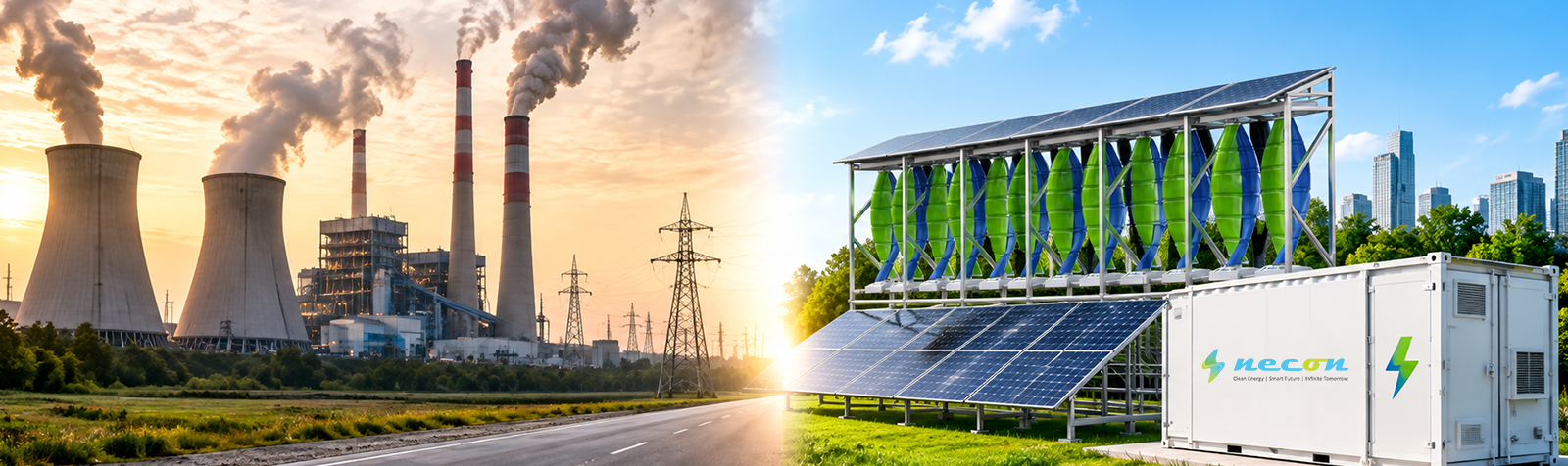
At NECON, we see this shift clearly. Solar parks will grow larger and smarter, and more of them will be built as hybrid parks that combine solar, wind, and Battery Energy Storage Systems.
If you want to explore NECON’s approach to large-scale systems, visit solar power parks and hybrid power parks.
What is a mega solar park
A mega solar park is a large area of land developed for solar projects, with common infrastructure in place. The Ministry of New and Renewable Energy (MNRE) explains that solar parks are developed with shared facilities such as transmission infrastructure, roads, water, drainage, and communication networks, along with statutory clearances. This allows developers to set up solar projects with fewer delays.
In simple terms, a solar park is like an industrial zone for clean power. Developers can focus on building generation, while the park developer and state agencies support site readiness and connectivity.
For official scheme details, see MNRE’s page on the development of solar parks and ultra mega solar power projects.
Why solar parks will matter more by 2030
India’s clean energy build-out is moving into a phase where speed and scale must be matched with grid readiness.
India has set a national target of 500 GW of non-fossil capacity by 2030. A key part of reaching this target is building enough transmission to evacuate power from renewable rich regions to demand centers.
In 2022, the Government of India launched a plan for a transmission system to integrate over 500 GW of renewable energy capacity by 2030, including a broader roadmap for about 537 GW of renewable capacity by 2030. The plan also highlights the role of storage and high-voltage corridors to move power reliably.
You can read the official announcement here: PIB press release on transmission planning for 500 GW by 2030.
Solar parks will benefit from this grid expansion because many of the largest parks are located in high solar potential regions that need strong transmission links.
The solar park scheme and what it tells us about direction
India has an established policy framework for solar parks.
SECI describes the “Development of Solar Parks and Ultra Mega Solar Power Projects” scheme as being notified in December 2014 and enhanced in 2017. SECI also notes that the scheme aims to set up at least 50 solar parks of 500 MW and above, targeting around 40 GW of installed solar capacity. SECI’s page also lists totals such as the number of parks and total capacity allocated.
For details, see SECI’s official page: solar park (SECI).
MNRE’s scheme page adds that the scheme capacity was enhanced from 20,000 MW to 40,000 MW, and that parks were proposed to be set up by 2025 to 2026 under the scheme timeline.
What does this tell us for 2030
Solar parks are already a proven model in India. By 2030, the market will likely go beyond the original scheme numbers, with larger parks, more hybrid designs, and a stronger focus on grid services, storage, and dispatchability.
Key trends shaping mega solar parks by 2030
Below are the trends most likely to shape what mega solar parks look like in the next few years.
Bigger parks, smarter infrastructure
Mega parks will continue to grow in capacity and complexity. The focus will shift from only building generation to building energy infrastructure.
That means better on-site planning for:
pooling stations and evacuation routes
reactive power and grid stability needs
cybersecurity and metering integrity
reliable operations and maintenance
NECON’s systems approach is built around this kind of integrated design. Learn more about how we think about long-term performance on innovation and technologies.
Hybridization will move from optional to standard
By 2030, many large solar parks will be designed as hybrid parks, or will connect to nearby wind zones and storage assets.
Why this matters
Solar output drops in the evening. Wind patterns can complement solar in many regions. Storage can shift energy to peak hours and smooth variability. Together, they can increase the usable clean energy delivered to the grid.
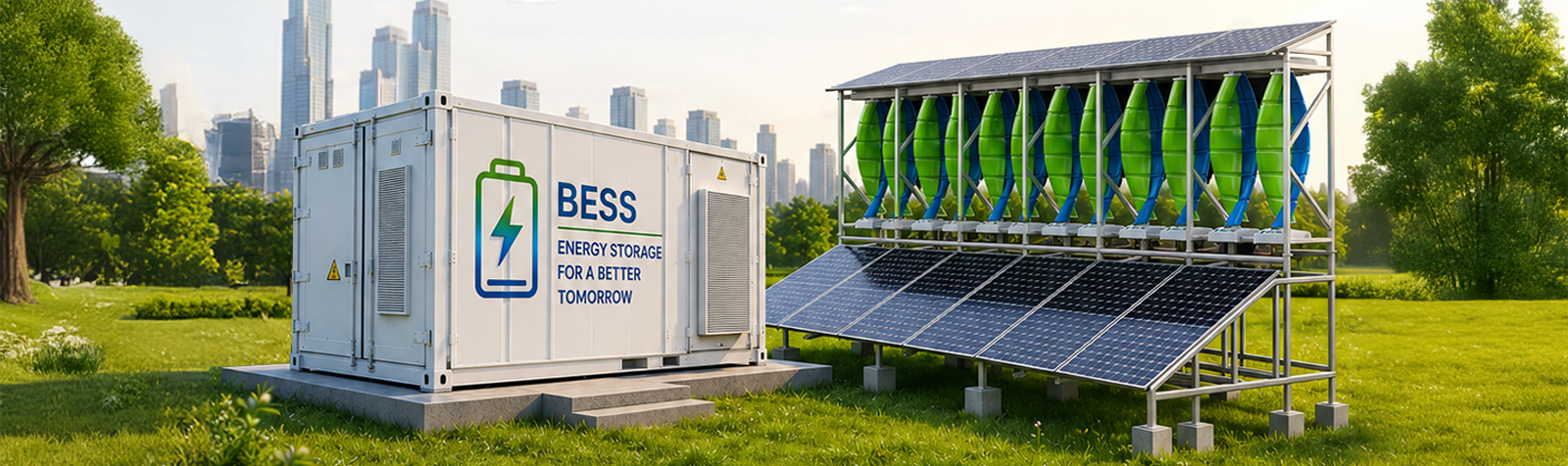
NECON is focused on this integrated model, combining solar, vertical wind, and storage for higher reliability. Explore hybrid power parks and the role of vertical axis windmill.
Storage and dispatchable renewables will define project value
By 2030, the biggest question for many mega solar parks will be:
How much power can you deliver when the grid needs it most
That pushes the market toward Battery Energy Storage Systems and smarter controls. Transmission planning documents also highlight storage as part of the path to round-the-clock renewable power.
For solar park developers and large buyers, storage changes the business case because it enables:
peak shaving and load shifting
reduced curtailment risk
firmer supply profiles for industrial demand
better participation in emerging market mechanisms
NECON’s hybrid roadmap is aligned with this direction, where generation and storage are designed together, not bolted on later.
Transmission planning will decide which parks scale fastest
Land and solar resource are not enough. A mega solar park is only as valuable as its grid connection.
The Central Electricity Authority’s transmission plan for integrating over 500 GW renewable energy capacity by 2030 includes high-voltage corridors and major renewable potential zones. The transmission plan also considers energy storage and round-the-clock requirements.
You can access the CEA plan summary document here: Transmission system for integration of over 500 GW RE capacity by 2030 (CEA, PDF).
For mega solar parks, this means that the best-performing developments will be the ones that align early with:
grid strengthening timelines
pooling station availability
inter-regional transmission capacity
realistic commissioning schedules
Domestic manufacturing and bankability will stay in focus
India is investing in renewable manufacturing and supply chain resilience. By 2030, buyers and lenders will keep asking clear questions about:
equipment quality and long-term performance
warranty strength and service coverage
supply reliability and timelines
operational track record
NECON’s solar solutions are engineered for long-term, real-world reliability, including utility and hybrid contexts. See solar power parks.
Challenges mega solar parks must solve before 2030
Even with strong momentum, mega parks face real execution challenges. The most important ones are solvable, but they need planning.
Land and community alignment
Large projects need large land areas. This requires early engagement, clear processes, and responsible development. Without this, timelines slip.
Water and site sustainability
Solar parks can require water for cleaning and construction. MNRE has issued advisories and scheme documents related to water usage in solar projects. This will matter more as parks expand into drier regions.
Curtailment and system balancing
As more solar comes online, the grid must balance supply and demand in real time. Without storage, flexible generation, and stronger networks, curtailment risk rises.
This is one reason hybrid and storage backed parks will become more attractive by 2030.
Long-term O&M performance
Many projects are designed for the build phase, not the 25 year operating life. By 2030, investors and large power buyers will pay more attention to operations, maintenance, and performance monitoring.
NECON’s end-to-end mindset supports this shift. Our mission is built around dependable, future-ready clean energy systems. Learn more on our story.
What the 2030 solar park looks like in practice
By 2030, the most competitive mega solar parks are likely to look like large energy campuses.
They may include:
utility-scale solar generation as the core
wind integration where local wind conditions support it
battery storage to firm supply and reduce variability
advanced control systems for stable operations
strong transmission connectivity for evacuation
This is also why hybrid parks are becoming a priority for many stakeholders. They help move the conversation from installed capacity to usable, reliable clean power.
How NECON supports the next generation of large solar parks
NECON works across technologies that matter for the next decade of solar parks.
Our role is to help customers move from a simple solar build to a complete clean power system that can scale.
This includes:
high-performance solar modules designed for utility and hybrid parks: solar power parks
hybrid design that combines solar, wind, and storage for higher reliability: hybrid power parks
wind technology built for integration and diverse environments: vertical axis windmill
innovation driven engineering for long-term resilience: innovation and technologies
We also stay aligned with sustainability outcomes beyond kilowatt-hours, supporting decarbonization journeys and responsible infrastructure. Learn more on sustainability.
Conclusion
Mega solar parks in India will keep expanding through 2030, but the definition of success will change.
The most important parks will not only be the largest. They will be the ones that deliver reliable clean power with strong grid connectivity, smart controls, and storage or hybrid support.
As India works toward its 2030 clean energy goals, mega solar parks can act as the backbone of the transition. The future belongs to parks that are engineered as complete energy systems, not just generation sites.
Talk to NECON
If you are planning a solar park, hybrid power park, or storage-backed renewable project, NECON can support you with future-ready system design and scalable technology options.
Connect with us here: reach us.